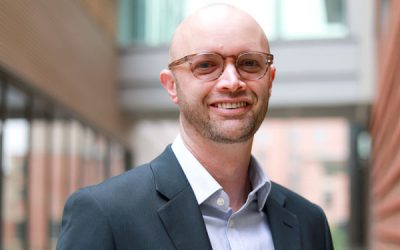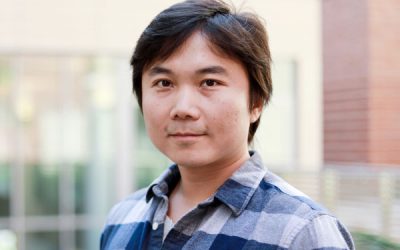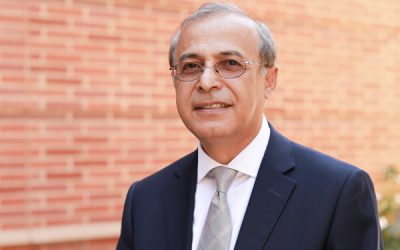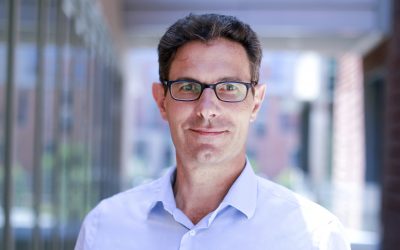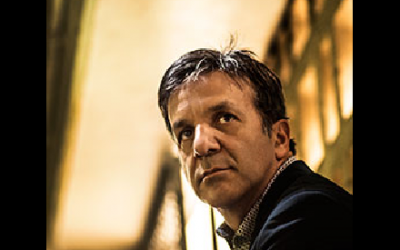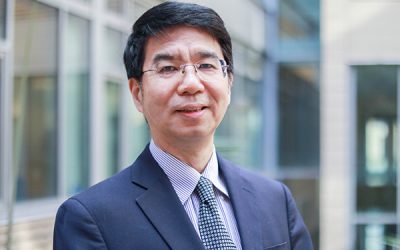
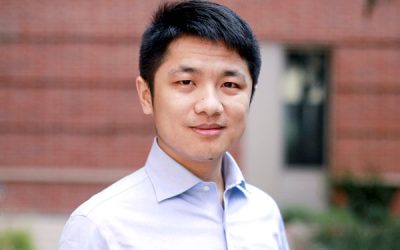
Dr. Lin Yang is an assistant professor in the Electrical and Computer Engineering Department at the University of California, Los Angeles. His research focuses on developing and applying fast algorithms for machine learning and data science. His current research focus is on reinforcement learning theory and applications, learning for control, non-convex optimization, and streaming algorithms. Previously, he was a postdoc at Princeton University. He obtained two Ph.D. degrees (in Computer Science and in Physics & Astronomy) from Johns Hopkins University. He was a recipient of the Simons’ Research Fellowship and Dean Robert H. Roy Fellowship.
Electrical and Computer Engineering
Corey Arnold
Katsushi Arisaka
Xiang Anthony Chen
Anthony’s research mission is to expand the interaction bandwidth between human and AI, specifically, enabling domain-specific users to comprehend and control AI with an eventual vision of human-AI collaboration. He received his Ph.D. in the School of Computer Science at Carnegie Mellon University in 2017 and was a recipient of the Hellman Fellowship, NSF CISE CRII Award and the Adobe Ph.D. Fellowship. Anthony’s work has won two best paper awards and two honorable mentioned in top-tier HCI conferences.
Achuta Kadambi
Achuta Kadambi (PhD, MIT ‘18) is a tenured Associate Professor at UCLA in Electrical Engineering and Computer Science. He leads an AI research group that focuses on computer vision and spatial intelligence. He has co-founded two California companies: Akasha Imaging (acquired in 2022, now with Alphabet) and Vayu Robotics (acquired in 2025, now with Nasdaq: SERV).
He is the recipient of early career awards including from NSF (CAREER), DARPA (YFA), ARO (YIP), IEEE (HKN under 35 award), and Forbes (30 under 30). He is an inventor on 40+ issued US patents and has recently co-authored a textbook on computational imaging, published by the MIT Press.
Panagiotis Christofides
Ali Mosleh
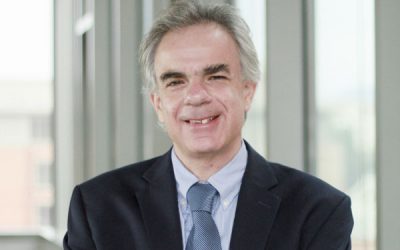
Reliability engineering, physics of failure modeling and system life prediction, resilient systems design, prognostics and health monitoring, hybrid systems simulation, theories and techniques for risk and safety analysis.