
UCLA Bioengineering Alum and Physician Combines Engineering and Medicine to Develop Wearable Sensors for Personalized Skin Disease Monitoring and Treatment
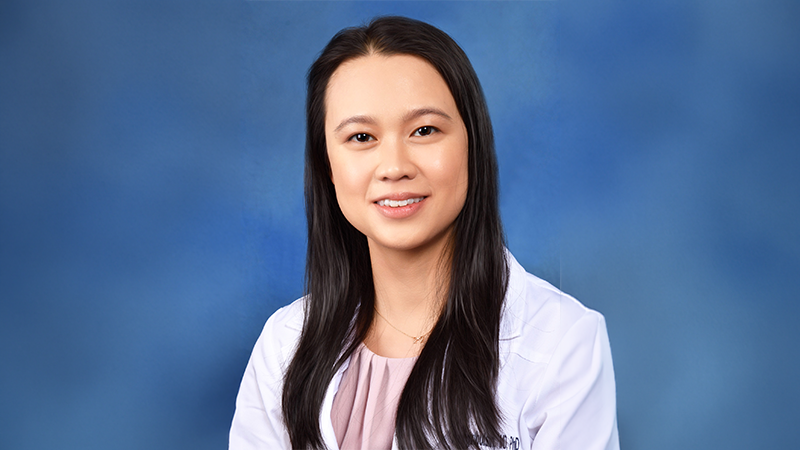
Courtesy of Shannon Wongvibulsin
UCLA Samueli Newsroom
Shannon Wongvibulsin ’14 was still a high school senior, months away from enrolling at UCLA, when a game of bingo helped set the course of her career.
At Discover Engineering, the annual open house for admitted students at the UCLA Samueli School of Engineering, Wongvibulsin played a bioengineering version of bingo called “B-E-n-g-o,” led by Daniel Kamei, a professor of bioengineering at UCLA Samueli, and learned about the research of Benjamin Wu, then professor and chair of the Bioengineering Department with a joint appointment in the dental school. Their conversation led to a spot in Wu’s lab the summer prior to her freshman year, before she had taken a single class at UCLA.
“Looking back, it is remarkable to think that a conversation at an open house could have such a lasting influence on the direction of my life,” said Wongvibulsin, who became an assistant professor of dermatology at UC Irvine in August.
A physician-scientist who treats patients in general and complex dermatology, she leads a research group developing technologies that combine optical sensing, imaging and artificial intelligence to improve the way skin diseases are diagnosed and monitored.
Dermatologists can examine visible changes on a patient’s skin, but the biological processes underlying those changes can be difficult to assess during routine appointments. Wongvibulsin’s lab is developing tools to make skin disease more measurable, including a small, non-invasive wearable that tracks skin changes over time. The device aims tocan detect biological signals tied to inflammation, an approach the lab is testing in patients with allergic contact dermatitis. The research could eventually allow clinicians to monitor patients’ conditions between visits and tailor treatment based on continuous, objective measurements.
An Upbringing that Embraces Curiosity and Problem-Solving
Growing up in Southern California, Wongvibulsin is the daughter of immigrants from Thailand. Her father was an engineer and her older brother studied computer science. But rather than simply following their career path, Wongvibulsin said her parents encouraged a curious mindset and love of learning. In particular, her mother created an environment where asking questions and exploring new ideas were always welcomed. Those values have had a lasting influence on how Wongvibulsin approaches her work.
“I am still driven by that same curiosity and desire to keep learning,” she said. “The environment my parents created for our family laid the foundation for the path I have taken, from engineering to medicine and ultimately to developing new technologies at the intersection of the two.”
As an undergraduate bioengineering researcher in Wu’s lab at UCLA, Wongvibulsin spent four years studying biomaterials and tissue engineering approaches to regenerate ligament, bone and cartilage. Her projects included modifying biodegradable materials to improve cell attachment and using 3D-printed sucrose as a dissolvable template for tissue scaffolds. Her research earned her a Barry M. Goldwater Scholarship, a prestigious undergraduate research honor. She was also selected for the Howard Hughes Undergraduate Research Program, which provided intensive training in scientific reasoning and communication.
A bioengineering capstone course taught by Dino Di Carlo, now chair of the Bioengineering Department and the Armond and Elena Hairapetian Professor of Engineering and Medicine, gave her a hands-on opportunity to write a mock National Institutes of Health (NIH) research proposal, conduct experiments and present her work at a UCLA symposium attended by guests from the biotechnology industry.
Outside the lab, Wongvibulsin served as director and editor-in-chief of Total Wellness Magazine, a UCLA student health publication that deepened her interest in patient care. Her research and extracurricular experiences helped her recognize that she wanted to combine engineering with clinical medicine rather than pursue either field alone.
Why Choose between an M.D. and Ph.D.?
After receiving UCLA Samueli’s 2014 Edward K. Rice Outstanding Bachelor’s Student Award, the school’s highest honor for a graduating senior, Wongvibulsin went on to earn her medical degree and a doctorate in biomedical engineering through the M.D.-Ph.D. program at Johns Hopkins University.
At Johns Hopkins, her research focused on machine learning and clinical risk prediction, including a system designed to predict the risk of severe COVID-19 that was ultimately integrated into the Johns Hopkins electronic medical record system.
“Relationships formed at UCLA can continue to shape your path many years later,” said Shannon Wongvibulsin.
It was also during this time that her interest in dermatology began to take shape, especially because of its highly visual nature.
“The skin provides an accessible window into health, and subtle patterns can offer important clues for diagnosis and treatment. Yet much of the biology underlying skin disease is not visible at the surface,” she said. “This creates tremendous opportunities for imaging, sensing, and AI to provide information that complements clinical assessment.
Following her M.D. and Ph.D., Wongvibulsin returned to UCLA for a dermatology residency and the Specialty Training and Advanced Research (STAR) Program, which provides protected research time alongside clinical training. Supported by the program and a Dermatology Foundation fellowship, she conducted postdoctoral research in the laboratory of Aydogan Ozcan, the Volgenau Professor of Engineering Innovation and a professor of electrical and computer engineering and bioengineering at UCLA Samueli. Ozcan’s research group combines optics, AI and computation to develop imaging, sensing and diagnostic tools.
Wongvibulsin, who first encountered Ozcan’s research as an undergraduate, credits the experience with helping shape her approach to developing engineering technologies for clinical use.
“He is incredibly generous with his time and feedback while also giving trainees the independence to develop their own ideas,” Wongvibulsin said. “That balance helped me grow both scientifically and personally as an independent investigator.”
Once a Bruin, Always a Bruin
Her connections to UCLA continue today. Di Carlo is now part of the mentorship team for her application for an NIH Mentored Clinical Scientist Development Award, which supports research training for early-career physician-scientists.
“It is a wonderful reminder of how relationships formed at UCLA can continue to shape your path many years later,” Wongvibulsin said.
She has also returned to the event that helped launch her career, regularly participating in Discover Engineering to speak with prospective students.
“Standing on the other side of that experience, speaking with students who are considering UCLA and sharing my own journey, has given me a new appreciation for how influential that first open house was for me,” she said.
Looking ahead, Wongvibulsin said she aspires to build an interdisciplinary ecosystem where clinicians, engineers and data scientists can work together to develop and translate technologies that improve patient care.
“My long-term vision is to transform dermatology from a field that often relies on episodic, subjective assessments into one that is quantitative, continuous and individualized to each patient through data-driven insights,” she said.