
UCLA Samueli's Class of 2026 Outstanding Bachelor Seeks to Improve Lives Through Engineering
Courtesy of Ereni Delis
UCLA Samueli Newsroom
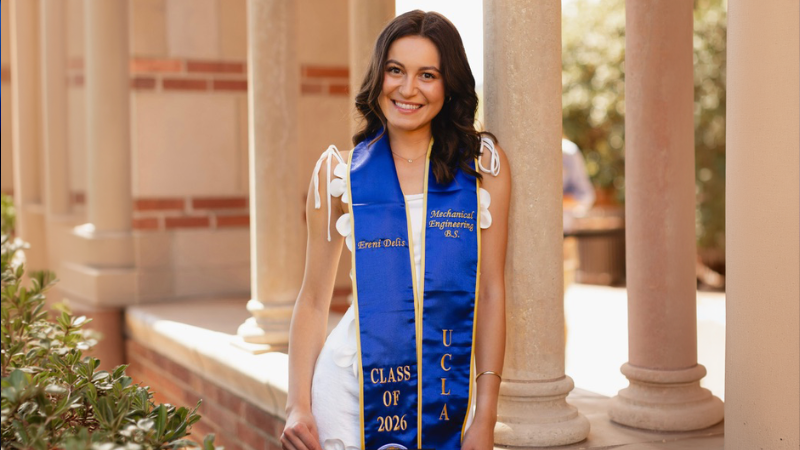
Graduating mechanical engineering student Ereni Delis still remembers the first time her grandmother, whom she affectionately calls “yiayia,” the Greek word for grandmother, visited UCLA. The two walked through the Physics and Astronomy Building — one of Delis’ favorite places on campus. It was at that moment she realized becoming an engineer would be far harder than she’d imagined, though she was also up to the challenge.
As they reached the exit, her grandmother turned to her and said, “I get to walk these halls because of you.” Delis saw it the other way around. “I walked those halls because of her,” Delis said. “This journey to UCLA began long before me.”
Delis’ grandparents grew up in small mountain villages in Greece without running water, electricity or much food. They immigrated to the United States as young adults without knowing English or having any family in the country. What they did have was a vision that their children, and every generation after, would be educated. Her family’s courage and sacrifice helped shape Delis’ outlook on hard work and perseverance.
In second grade, Delis remembered getting a bright blue mailer from her mother. The Hellenic Foundation’s fundraising piece included a line from Aristotle: “Excellence is not an act, but a habit.” The message from the Greek philosopher inspired her greatly, not only because it resonated with her heritage, but also because it aligned with her desire to continue the tradition of excellence in innovation and scientific discovery associated with the ancient Greeks.
Despite having no background in science, technology, engineering and mathematics, Delis’ parents encouraged her love of physics and calculus in high school. Engineering, she said, combines her two favorite subjects and gave her a new lens for understanding the world. So, when it came time to pick a major at the UCLA Samueli School of Engineering, she chose mechanical engineering for its breadth of topics and vast applications.
Delis spent more than two years in the Anatomical Engineering Group, a UCLA Samueli lab led by Tyler Clites, an assistant professor of mechanical and aerospace engineering, where researchers design devices that work with the human body. Her projects included a flexible implant for severe elbow fractures and early-stage research toward a neuroprosthesis that could restore blinking for people with facial paralysis. The latter project grew out of a long-held fascination.
“I believe the human brain is one of the greatest intellectual mysteries, and it’s a black box I’ve always been interested in exploring,” Delis said. “As an engineer, I’m particularly excited about how we can better understand the connection between our brain and body, and specifically how we produce everyday movements, like blinking.”
“I am most fulfilled when my work can make a meaningful difference in someone else’s life,” said Ereni Delis, who plans to pursue both a M.S. and Ph.D. in mechanical engineering.
Working with a graduate student and an ophthalmic surgeon, Delis helped run clinical trials that recorded how healthy eyelids move and how different neural signals drive the orbicularis oculi, the muscle that opens and closes the eye. She processed the motion-capture data to map continuous blink trajectories and co-authored the study, which was published in the Proceedings of the National Academy of Sciences and laid the groundwork for a device to help people who have lost the ability to blink.
Her other major project came through the Clare Boothe Luce Scholars Program, a two-year fellowship that supports women pursuing research in engineering and the physical sciences. It allowed Delis to lead an independent study as an undergraduate on a new design for a radial head implant used after severe elbow fractures. Traditional implants are rigid, so even a slight surgical misplacement can press hard on the joint and cause pain, stiffness and, in some cases, revision surgery. Delis’ version builds in flexibility that allows the implant to adapt to the patient’s elbow while supporting it. The device has been manufactured, and she is collecting experimental data and preparing a first-authored paper.
Aside from research, Delis was also involved in student mentorship. She joined the Tau Beta Pi engineering honor society her sophomore year as a volunteer tutor for engineering and physical science undergraduate students. She later became its tutoring director, leading more than 30 tutors who help undergraduates tackle thermodynamics, differential equations and circuit design. “I am passionate about teaching and about passing on the knowledge I have acquired throughout my time at UCLA,” she said.
Delis was also involved in Bruin Formula Racing, the first engineering student-led organization she joined at UCLA, and was one of six women on the team of more than 90 students at the time. Her work on the fuel baffle team included a redesign that yielded eight prototypes and creative methods to measure acceleration and fuel sloshing. From this experience, Delis learned that engineering is an iterative process and that even the smallest components can play a critical role in a system’s overall performance.
Music, which has played a major role in Delis’ life, offers a much-needed pause from the intensity of engineering and serves as an artistic outlet. She sang in a traveling girls chorus for 10 years before joining UCLA Chorale during her first quarter on campus.
Outside of UCLA, Delis pursued internship opportunities so she could apply what she learned in the classroom to real-world settings. At SLAC National Accelerator Laboratory, for example, she developed mechanical testing methods for recyclable-by-design polymers through a project tied to the U.S. Department of Energy. At Northrop Grumman, she worked on large-scale satellite production and systems testing. For nearly two and a half years, she also served as a congressional intern, where she handled constituent cases, worked on proceedings files and helped develop a STEM advocacy event that brought together NASA Jet Propulsion Laboratory engineers and MIT researchers with more than 500 middle school students.
This spring, Delis graduates as the schoolwide Outstanding Bachelor of Science for the Class of 2026. She said the honor reflects the effort she invested throughout her education and reminds her of a favorite quote on the John Wooden statue in front of Pauley Pavilion: “Success is peace of mind which is a direct result of self-satisfaction in knowing you made the effort to become the best of which you are capable.”
After graduation, Delis will continue her education at Stanford University for a master’s degree in mechanical engineering. Supported by a National Science Foundation Graduate Research Fellowship, she plans to continue advancing her neuroprosthesis design for blinking. Across implant, blinking research, polymers and satellites, Delis sees a single throughline. She says she wants her work to have a positive impact on people, and that means learning directly from clinicians and patients so she can build what they need most.
“I am most fulfilled when my work can make a meaningful difference in someone else’s life,” said Delis, who also plans to pursue a Ph.D. in mechanical engineering. “I’m committed to paying forward my education to help patients in need of solutions that do not yet exist.”