
UCLA Engineering Professor Nasim Annabi Receives Nearly $2.5 Million in NIH Funding to Develop Tunable Biomaterials for Corneal Repair and Wound Healing
Annabi Lab/UCLA
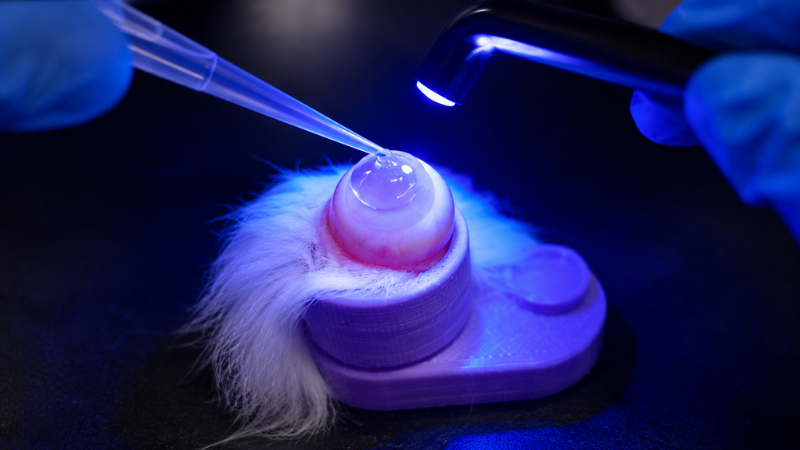
The light-curable bioadhesive hydrogel developed by Annabi’s team is designed to promote corneal tissue regeneration.
UCLA Samueli Newsroom
Nasim Annabi, an associate professor of chemical and biomolecular engineering at the UCLA Samueli School of Engineering, has received two grants from the National Institutes of Health to support her research on developing regenerative biomaterials and bioadhesive therapies.
Bioadhesive Hydrogel for Corneal Tissue Regeneration
The first award is a four-year grant totaling more than $2 million from the National Eye Institute, part of the NIH, to develop biomaterials that can deliver stem cells to treat corneal injuries. Current therapies are limited in their ability to promote tissue repair, often leading to complications such as ulceration, scarring or fibrosis. Mesenchymal stem cells, known as MSCs, have shown promise in therapy for eye injuries because they release signals that reduce inflammation and support healing. However, when applied directly to the ocular surface — the cornea and surrounding outer tissues of the eye — the cells do not stay in place or survive well, limiting their effectiveness.
To address this challenge, Annabi proposes encapsulating MSCs in a minimally invasive, biodegradable adhesive hydrogel that mimics the physical and chemical properties of corneal tissue. The light-curable material, based on chemically modified gelatin and hyaluronic acid, is designed to release MSCs and promote corneal tissue regeneration.
Annabi’s lab will develop two types of cell-laden hydrogels with distinct properties. One is a softer adhesive with controlled degradation, designed to release MSCs and support the growth of the eye’s outermost layer, or corneal epithelium. The other is a stronger, highly adhesive material intended to seal and repair damaged tissue while serving as a sustained delivery platform for the cells.
The approach could improve treatment outcomes for eye injuries by overcoming the limitations of existing therapies and reducing vision-related complications.
Bioadhesive, Anti-Inflammatory Dressing to Heal Chronic Wounds
A second grant, totaling about $368,000 over two years from NIH’s National Institute of Arthritis and Musculoskeletal and Skin Diseases, will support the development of a skin-friendly bioadhesive wound dressing with anti-inflammatory properties that can effectively seal and heal chronic wounds. Current wound dressings provide physical protection but often do little to actively promote the healing process. Commercially available bioadhesives also have limited clinical efficacy due to their poor strength, inadequate anti-inflammatory properties, safety concerns and high costs.
Annabi’s research group developed UgiGel — a gelatin-based, self-healing bioadhesive produced through a simple one-step process that eliminates the need for catalysts, light activation and extensive purification steps common in traditional bioadhesive manufacturing. Recent work has shown that UgiGel is biocompatible and exhibits strong adhesion.
The new funding will support efforts to reformulate the material to improve its adhesion to wet tissue, enhance its antioxidant properties and promote temperature-responsive detachability to allow for painless removal from the skin. The research could lay the groundwork for a new generation of multifunctional wound-care materials that not only protect wounds but also accelerate healing.
Annabi, who is a member of the California NanoSystems Institute at UCLA, will evaluate the wound-sealing and healing potential of optimized UgiGel formulations in collaboration with Dr. Philip Scumpia, a clinical dermatologist and an associate professor of medicine at the David Geffen School of Medicine at UCLA.