
UCLA Computer Scientists Jason Cong and Jens Palsberg to Co-Lead 2 NSF Quantum Computing Institutes
The combined $75 million in grants aims to overcome critical barriers between today’s quantum systems and practical computing
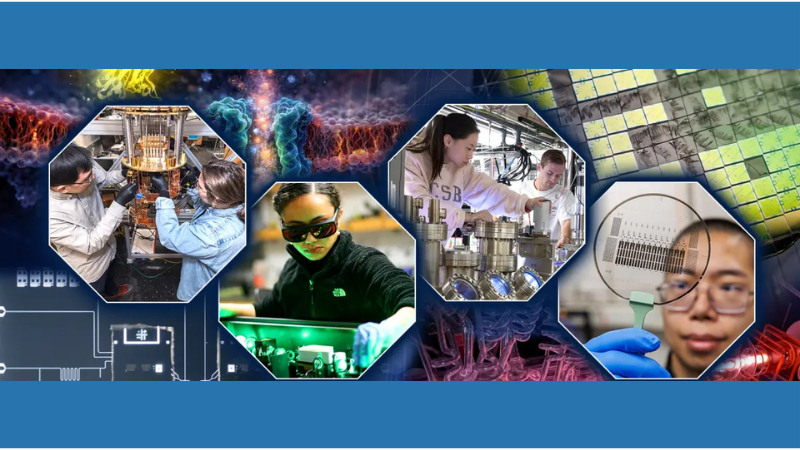
Courtesy of the National Science Foundation
The NSF Quantum Leap Challenge Institutes are taking on some of the hardest scientific hurdles in the global race to create powerful quantum-based technologies.
UCLA Samueli Newsroom
Two computer scientists from the UCLA Samueli School of Engineering have been selected as co-principal investigators on separate quantum computing institutes funded by the National Science Foundation’s Quantum Leap Challenge Institutes (QLCI).
The five-year grants of $37.5 million each will support two research institutes aimed at overcoming fundamental barriers in quantum information science and accelerating the development of quantum technologies for practical applications.
The two institutes are part of eight QLCI awards totaling more than $290 million announced today by the NSF to propel U.S. quantum science in the global race to create powerful quantum technologies. The investment is an expansion of the QLCI program created in 2020 following the passage of the National Quantum Initiative Act in 2018.
Newly Established NSF Institute for Fault-Tolerant Quantum Systems, Architectures and Applications
The institute for Fault-Tolerant Quantum Systems, Architectures and Applications (FTQSAA) is one of three newly formed institutes in the program led by Harvard University, with UCLA Samueli and MIT serving as co-leads. The multi-institutional research team will focus on developing quantum systems that can reliably perform useful computations despite the errors and noise that disrupt quantum devices. The researchers will integrate fault-tolerant design across quantum hardware, software, algorithms and applications to maximize quantum systems’ ability to solve previously intractable problems in fields ranging from drug and materials discovery to particle physics and cosmology.
Jason Cong, a distinguished professor of computer science at UCLA Samueli and holder of the Volgenau Chair for Engineering Excellence, is a co-principal investigator of the institute. He will lead UCLA’s efforts to develop software, algorithms and AI-based tools that make fault-tolerant quantum systems more efficient and better able to operate in the presence of errors.
“Producing fault-tolerant quantum devices is critical to solving a range of scientific and technological problems currently unsolvable by classical methods,” Cong said. “Our goal is to develop new compilation, quantum error-correction and AI-driven simulation and optimization techniques that improve the reliability and efficiency of quantum systems and help move fault-tolerant quantum computing toward practical applications.”
Three other faculty members are part of UCLA’s FTQSAA team: Yizhou Sun, a professor of computer science; Hanrui Wang, an incoming assistant professor of computer science; and Leo Zhou, an assistant professor of electrical and computer engineering.
At UCLA, Cong holds a joint faculty appointment in the Department of Electrical and Computer Engineering and directs the Center for Domain-Specific Computing. He is also a faculty member with the California NanoSystems Institute and a research thrust lead at UCLA Samueli’s newly launched Semiconductor Hub.
Expanded NSF Quantum Leap Challenge Institute for Quantum Computation
The NSF Challenge Institute for Quantum Computation (CIQC), a California-based research network, is led by UC Berkeley and includes researchers from UCLA, UC Santa Barbara, the California Institute of Technology and Stanford University.
Established in 2020 with an initial seven-year, $32 million grant, the institute has brought together researchers in chemistry, computer science, engineering, mathematics and physics to rigorously test claims of quantum advantage and help drive advances across the quantum industry. Their work has revealed new quantum phase transitions, deepened understanding of quantum matter and advanced neutral-atom platforms for quantum computing, helping lay the groundwork for growing activity and investment in the field.
With a renewed five-year, $37.5 million NSF grant, the multi-institutional team will address three major challenges: discovering and realizing the power of quantum computation, understanding nature through the lens of quantum information science, and developing quantum technologies and their applications.
Jens Palsberg, a computer science professor at UCLA Samueli and co-director of the Center for Quantum Science & Engineering (CQSE), is a co-principal investigator of the institute. He will lead a team of UCLA researchers that includes physics professors Wes Campbell and Eric Hudson, who is the director of CQSE. Richard Ross, director of the UCLA Master of Quantum Science and Technology degree program, and David Steuerman, executive director of CQSE, are also part of the team.
The UCLA researchers will focus on the institute’s third research challenge — developing quantum technologies and their applications.
“Quantum computers have the potential to solve problems that are out of reach for today’s computers, but we still have a lot of work to do to get there,” said Palsberg, who is also the faculty director of the Science Hub for Humanity and Artificial Intelligence at UCLA. “We want to overcome bottlenecks in today’s trapped-ion quantum computing platforms and develop a universal software stack to compare different quantum technologies and help identify the applications where quantum computers can make the biggest difference.”