
New UCLA Engineering Studies Aim to Slow Battery Aging While Idle
Li Research Group/UCLA
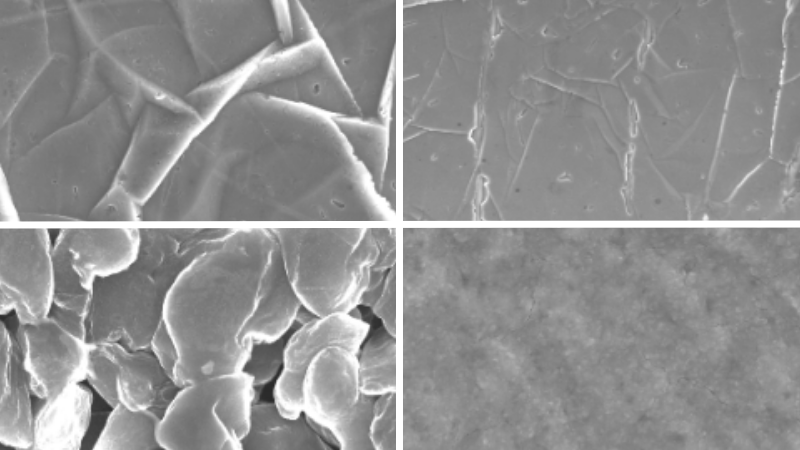
Scanning electron microscope images comparing how (from left to right, clockwise) magnesium, aluminum, sodium and lithium metal anodes degrade after resting
Most batteries spend more than 70% of their lifetime at rest. Yet few studies have examined calendar aging, which is how a battery degrades when it is neither charging nor being used.
Now, a pair of complementary papers published in Joule and Nature Communications, both led by chemical engineers at the UCLA Samueli School of Engineering, has found that many next-generation metal-anode batteries can lose significant capacity during calendar aging. Across the two studies, the researchers compared losses for various metals and designed strategies to reduce them, providing new pathways to extend battery life.
Metals such as zinc, sodium and magnesium are being explored as alternatives to lithium-ion batteries for their potential to store more energy. To evaluate their performance, most studies have focused on cycling efficiency — how efficiently the battery recovers charge over repeated use. It is often assumed that if a battery cycles well, it will also remain stable while idle. But cycling performance alone does not tell the full story of how a battery holds up in real-world use.
“We understand very little about how next-generation metal batteries degrade during rest,” said Yuzhang Li, an associate professor of chemical and biomolecular engineering at UCLA Samueli and the corresponding author on both papers. “These two papers further our understanding and present new concepts on how to improve battery aging during rest.”
The Joule paper investigates how different metal anodes age over time when they’re not in use. The research team looked at batteries based on lithium, sodium, aluminum and magnesium. All of them showed high cycling efficiencies. Yet, after two weeks of sitting unused, lithium, sodium and aluminum batteries had each lost roughly a tenth to a fifth of their capacity — losses that would add up quickly over a battery’s lifetime. Magnesium, by contrast, lost less than half a percent due to a naturally formed protective layer on its anode during rest that significantly limits corrosion. The protective layer reversibly dissolves once the battery begins charging, making the interphase on magnesium uniquely stable and dynamic.
The Nature Communications paper outlines a strategy to reduce corrosion in zinc-anode batteries by redesigning the electrolyte — the liquid that carries ions between the cathode and anode. The team found that water molecules surrounding dissolved zinc ions were substantially more reactive than free water molecules in the bulk electrolyte, making them a major driver of zinc corrosion. A conventional zinc battery electrolyte can lose more than a third of its capacity after just one day of sitting idle. By creating an ultra-dilute electrolyte and adding specific ingredients, the team cut that loss to less than 1.5% after 24 hours, while still maintaining stable performance over thousands of charge cycles.
While this particular paper focused on zinc, the concept could be broadly applicable to other metal-anode batteries, the researchers said.
“Together, these papers suggest that battery aging during rest can be reduced by fine-tuning the electrolyte environment and encouraging protective layer formation on electrodes,” Li said. “These two findings shift battery design from focusing mainly on cycling performance toward improving total lifetime under real-world use.”
The research is still at the proof-of-concept stage and further work is needed to validate the design principles in larger-format cells under practical operating conditions and over longer lifetimes. Ultimately, the findings could lead to commercial batteries with longer lifetimes, improving electric vehicle range and enabling more sustainable grid applications.
The Joule study was funded by the DEVCOM Army Research Office Energy Sciences Competency Advanced Energy Materials Program, the National Science Foundation and the Electrochemical Society Toyota Young Investigator Fellowship. The authors include Jin Koo Kim and Min-Ho Kim, both co-lead authors who were postdoctoral scholars in Li’s research group; Chongzhen Wang, Jung Tae Kim, Kaiyan Liang, Hayoung Park, Huida Lyu, Bo Liu, Xintong Yuan, Dingyi Zhao, Tian-Yu Wang and Kaixi Chen, all current or former members of Li’s group; and John Waugh and John Muldoon of the Toyota Research Institute of North America.
The Nature Communications study was funded by the U.S. Army Research Office and the University of California. In addition to Li, other co-lead authors are Haoyang Wu, Bo Liu and Dingyi Zhao, all current or former members of Li’s group. Other authors include Dongfang Cheng, Keyue Liang, Xintong Yuan, Kaixi Chen, Min-Ho Kim, Kaiyan Liang, Jung Tae Kim, Jiayi Yu and Tian-Yu Wang — all current or former UCLA graduate students and postdoctoral scholars in chemical and biomolecular engineering; and Philippe Sautet, a distinguished professor of chemical and biomolecular engineering, chemistry and biochemistry and holder of UCLA Samueli’s Levi James Knight, Jr. Term Chair for Excellence. Both Sautet and Li are also members of the California NanoSystems Institute at UCLA.