
NSF Awards Nearly $1 Million to Fund Three UCLA Engineering Research Projects
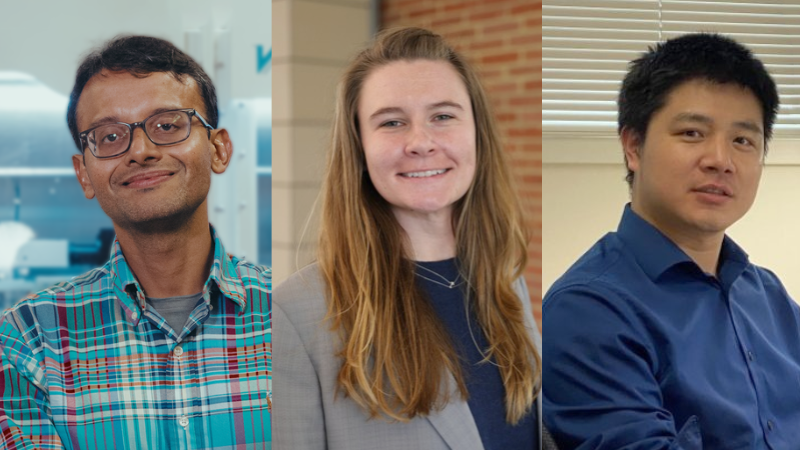
From left, Shafayat Hossain, Liz Izhikevich and Tiwei Wei are principal investigators on research projects funded by National Science Foundation awards.
Three assistant professors at the UCLA Samueli School of Engineering have received National Science Foundation grants totaling $930,000 to advance their respective research in quantum materials, satellite internet reliability and semiconductor packaging.
Shafayat Hossain, an assistant professor of materials science and engineering, received a three-year, $570,000 grant; Liz Izhikevich, an assistant professor of electrical and computer engineering received a two-year, $260,000 grant; and Tiwei Wei, an assistant professor of mechanical and aerospace engineering, received a two-year, $100,000 grant.

Shafayat Hossain
Advancing Quantum Materials for Faster Electronics
Hossain’s team is investigating topological materials that could enable faster, more energy-efficient electronics. These quantum materials have unusual electronic properties that can protect electron movement against certain disturbances, potentially reducing the energy lost through electrical resistance.
His research will explore ways to improve electron transport at room temperature by controlling interactions between electrons and the vibrations of a material’s atomic structure. The goal is to develop materials that preserve the properties of topological insulators under practical conditions. At UCLA, Hossain leads the Quantum Materials Intelligence & Nano Devices Lab and is a member of the California NanoSystems Institute. He received a 2026 Defense Advanced Research Projects Agency Young Faculty Award and the 2026 Materials Today Rising Star Award in Quantum Materials & Electronics. Working with co-investigator Alexander Balandin, the Fang Lu Professor in Engineering and a distinguished professor of materials science and engineering at UCLA Samueli, Hossain will explore ways to improve electron transport at room temperature by controlling interactions between electrons and the vibrations of a material’s atomic structure.
Liz Izhikevich
Improving Satellite Internet Reliability at Sea
Izhikevich is studying the reliability of low Earth orbit satellite internet connections aboard ships. Vessels operating far from shore depend on satellite networks for communications, weather updates and other essential services, making slow connections and outages potentially disruptive.
Her team will develop new ways to measure internet performance on vessels around the world without installing specialized equipment aboard ships. The researchers will study connection speed, delays and outages, as well as how a vessel’s location and movement affect reliability. The findings could help identify weaknesses in maritime satellite internet service and inform improvements. Izhikevich leads UCLA Samueli’s Security and Networking Lab. She was named to Forbes’ 2025 30 under 30 list in science and is a UCLA AI in Teaching Faculty Fellow for 2026-27.
Tiwei Wei
Improving the Reliability of Advanced Semiconductor Packaging
Wei is developing methods to measure temperature and mechanical stress inside three-dimensional semiconductor packaging. As transistors and their interconnections are packed more densely on chips, heat and stress can accumulate in areas that are difficult to access, reducing device performance and reliability.
Wei will combine optical measurement techniques with light-guiding structures integrated into semiconductor packages that can probe temperature and stress in inaccessible regions. The goal is to identify hotspots and concentrated stress areas, helping engineers design more reliable semiconductor technologies.
Wei leads the Thermal Science Laboratory for Semiconductor Packaging & Integration. He received the 2026 Institute of Electrical and Electronics Engineers Electronics Packaging Society Exceptional Technical Achievement Award and the 2026 American Society for Mechanical Engineers K-16 Outstanding Early Career in Thermal Management Award.