
UCLA Engineering Makerspace Donates 3D Printers to L.A. Middle and High Schools, Runs Training Workshops for Teachers and Students
Charlene Poon/UCLA Samueli
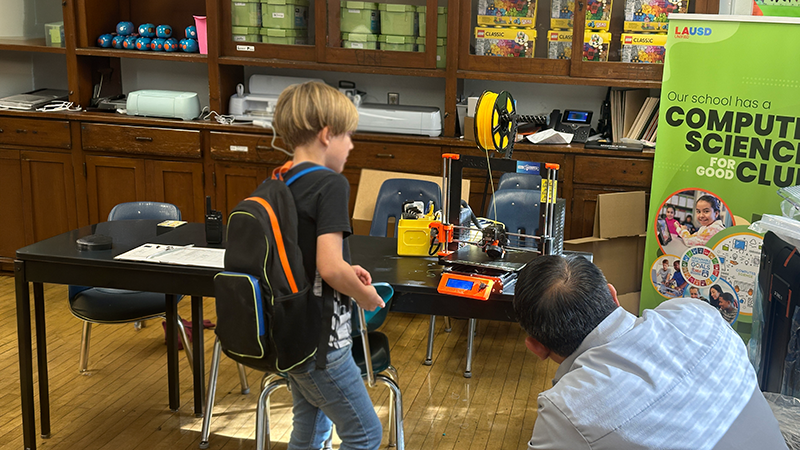
A student and teacher at Virgil Middle School pictured with a 3D printer donated by the UCLA Samueli Makerspace
UCLA Samueli Newsroom
When the UCLA Samueli Makerspace upgraded its fleet of 3D printers last fall to keep pace with rising student demand, it left a row of working Prusa MK3S+ machines sitting in storage. Rather than let them collect dust, a team of makerspace students began plotting a second life for the printers in classrooms across Los Angeles.
Working with the school’s Center for Excellence in Engineering and Diversity (CEED), the makerspace donated 10 printers during the 2026 winter quarter to Los Angeles-area middle and high schools through CEED’s UCLA Math Engineering Science Achievement pre-college program, one of California’s 19 MESA university centers designed to help economically disadvantaged middle and high school students to prepare for and pursue degrees in science, technology, engineering and mathematics. The printers found their new homes at Virgil Middle School; Birmingham, Inglewood United, Lawndale, San Fernando, Sylmar, University and Woodworth Monroe high schools; as well as Los Angeles Center for Enriched Studies Magnet middle and high school.
“I’m excited to see our students learn 21st century skills that they’ll also be able to use later in life to 3D print whatever they put their imagination to,” said Brandon Nguyen, a Virgil Middle School science teacher and double Bruin who received a bachelor’s in biology and a Master of Education. “It’s great exposure to seeing that STEM can be a creative endeavor.”
This spring, the effort expanded beyond printer donations. Students from the makerspace ran workshops at Virgil Middle School and Van Nuys Middle School STEAM Magnet, and delivered six more printers to additional schools across Los Angeles County. They ran two-hour hands-on workshops with students and left behind care packages stocked with tools, filament, replacement parts and repair guides.
The initiative was led by Suraj Shah ’25, M.S. ’26, a recent mechanical engineering graduate who started working at the makerspace since the first weeks of his freshman year at UCLA in 2021. In spring, he was awarded the Chancellor’s Service Award at commencement for his leadership in the makerspace and the UCLA chapter of Engineers Without Borders.
Shah first pitched the donation idea more than a year ago, when conversations about upgrading the printers began. He spent his winter break researching candidate schools, scouring websites and speaking with CEED director Catherine Douglas to assess which schools could best put a printer to use.
The focus was on schools in Los Angeles, many within the L.A. Unified School District, that have low graduation rates and limited external funding. Shah also prioritized schools with some existing infrastructure — a robotics club, an engineering magnet or a small makerspace — where a donated printer would land in capable hands.
“The students I’ve met have been some of the most passionate and engaged students,” Shah said. “I know that with the right resources and opportunities, they could go far.”
Charlene Poon/UCLA Samueli
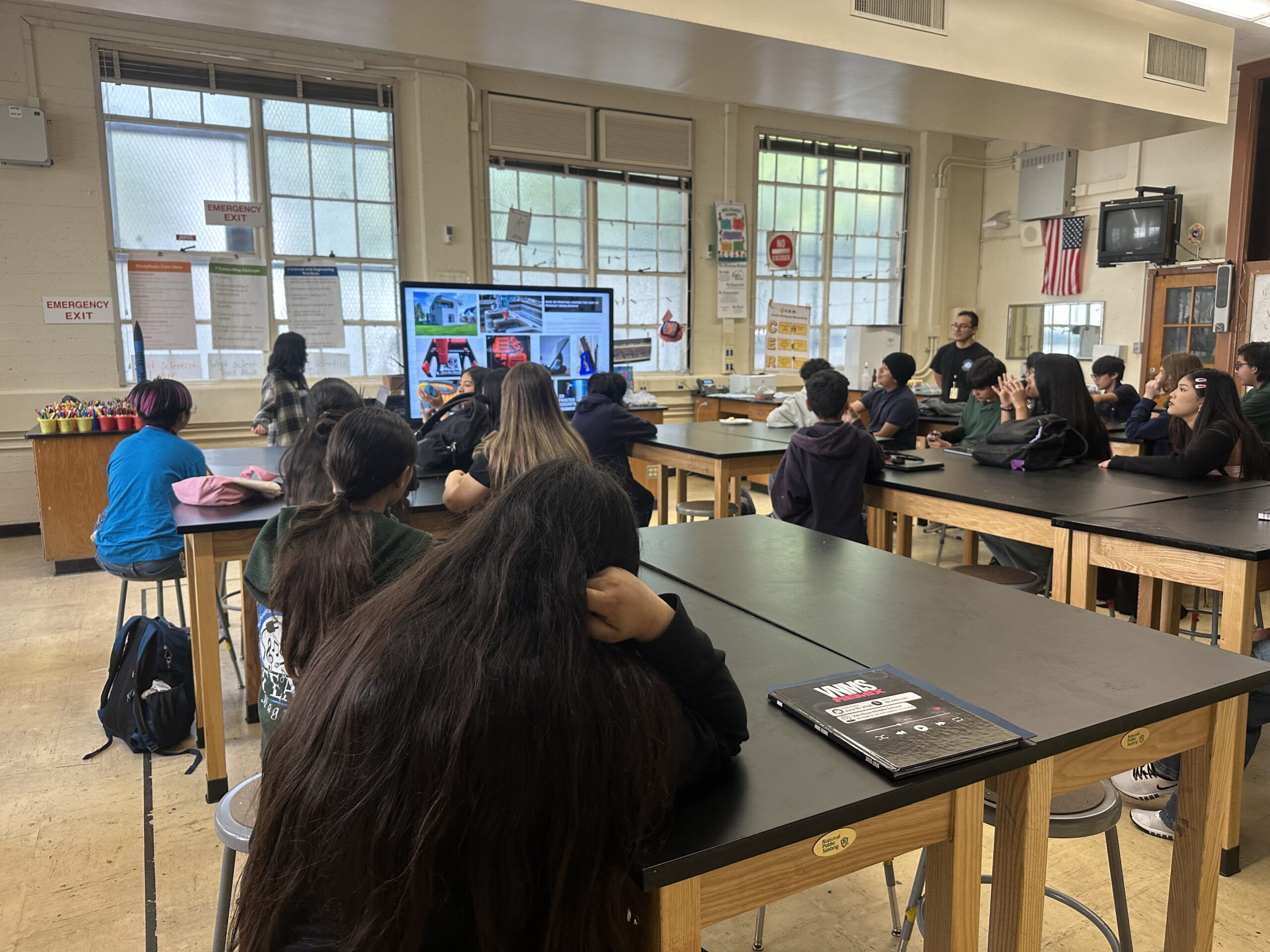
A Van Nuys Middle School STEAM Magnet class attends a 3D printing workshop led by students from the UCLA Samueli Makerspace
As with any new initiative, logistics have been among the biggest challenges. Sourcing and establishing contact with schools, refurbishing printers and navigating L.A. traffic for printer delivery and workshops are labor- and time-intensive. But the team is working through it one printer and one school at a time.
The Power of the Makerspace
The project grew out of the UCLA Engineering Makerspace, which is located on the first and second floors of Boelter Hall. The 9,000-square-foot facility is staffed by UCLA Samueli students and is open, free of charge, to all engineering students. It provides a hands-on learning space for capstone projects, group activities and personal creations, such as a self-playing piano that hits all 88 keys simultaneously. It is also where the school’s “Introduction to Engineering Design” ENGR 1 courses are held — from bionics to underwater robotics to go-kart design and building. Some of the classes are designed and taught by undergraduates who have demonstrated area expertise and have undergone training to become instructors.
“New or inexperienced students can feel more welcomed and less intimidated by seeing one of their peers in the space, and that helps them along the way,” said makerspace faculty director Jacob Schmidt, a professor and vice chair of undergraduate student affairs in the Bioengineering Department. That same student leadership model, he noted, is what made an outreach effort like Shah’s possible in the first place.
UCLA’s role, Schmidt said, isn’t just to hand off equipment. “It also involves training students and teachers on how to use and repair the equipment so that they can in turn train others and start up a makerspace of their own.”
For younger students, Schmidt said, the appeal of 3D printing goes beyond the technology itself.
“It is a really powerful feeling to design something on a computer and be holding the same object in your hands a few hours later,” he said. The quick turnaround and the ability to let students iterate, fail and try again, he added, are at the core of the engineering design process.
After arriving at a school, the UCLA team meets with the teacher, sets up pre-printed parts and displays a small collection of past projects to spark curiosity. PowerPoint presentations highlight real-world applications, while a live demonstration shows students how to load filament and start a print. Then the students get to build something themselves.
At Van Nuys Middle School STEAM Magnet — where a separate grant had already funded larger printers, so the team came to teach rather than donate printers — students assembled 3D-printed potted-plant fidget toys with key switches inside.
“It was amazing to see that some of the shy students were able to engage with the UCLA organization and their peers when it came time to collaborate,” said Jose Luis Sanchez, a seventh- and eighth-grade science teacher at the school.
Carrying the Work Forward
Shah has been working alongside Charlene Poon, a makerspace student co-director and a rising fourth-year mechanical engineering student pursuing her bachelor’s and master’s degrees concurrently, and Hannah Yang, a makerspace student co-director and rising third-year chemical engineering student. Together, the three have developed the care packages, refurbished the printers and run the workshops.
Yang is now leading the effort after Shah graduated, continuing to place printers in schools, run workshops and build relationships with teachers and students. The team is also exploring ways to invite schools to visit the makerspace and track how the donated printers are being used.
For Shah, the measure of success isn’t institutional. It’s the possibility that a student somewhere in L.A. picks up a printed part and decides engineering is the right career for them.
“Maybe they’ll come to UCLA, and one of them might look back on their time in school remembering how getting to use a 3D printer set them on course to pursue engineering,” said Shah, who joined Taiwan Semiconductor Manufacturing Company’s Phoenix, Arizona, operation in August as an equipment engineer in the firm’s lithography department. “The makerspace is a place to inspire people to make things. It doesn’t matter who or what age or where they are.”