
UCLA Engineers Observe Quantum Heat Waves at Room Temperature
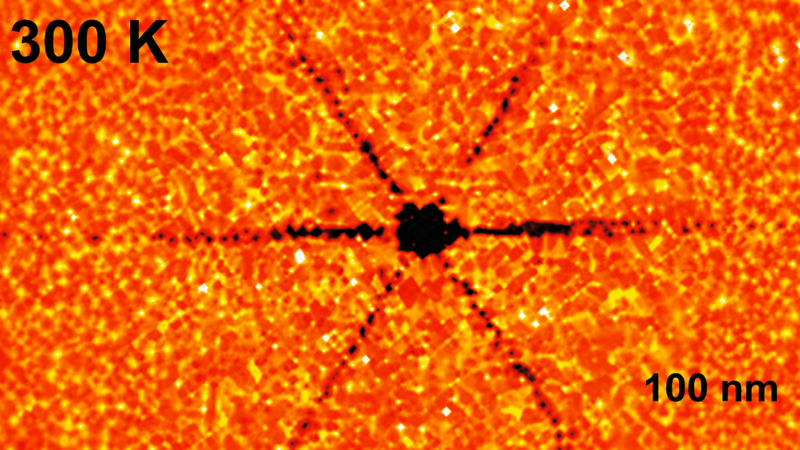
H-Lab/UCLA
Visualization of ray-like heat flow in boron arsenide at 300 K (80°F)
Efficient heat management in solids is key to advancing the next generation of electronics. However, wavelike heat movement — known as phonon focusing — had only been observed at extremely low, or cryogenic, temperatures, limiting its study and practical use.
Now, researchers at the UCLA Samueli School of Engineering have demonstrated that phonons, atomic heat-carrying vibrations with quantum properties, can travel in focused, ray-like paths at room temperature. Instead of spreading uniformly in all directions, heat can move along guided pathways defined by a material’s crystal structure, opening up new possibilities for managing heat flow in future electronics and quantum technologies.
Published today in Nature Physics, the study is led by Yongjie Hu, a professor of mechanical and aerospace engineering at UCLA Samueli. The team demonstrated phonon focusing at room temperature in boron arsenide, a crystalline semiconductor material with high thermal conductivity. Instead of removing heat after it spreads, materials like boron arsenide could enable heat to travel along predetermined routes with nanoscale precision, much like how optical fibers guide light.
To capture the effect, the researchers developed a nanoscale temperature-mapping technique. In conventional materials, the team observed circular heat-spreading patterns, consistent with ordinary diffusive heat conduction. In boron arsenide, however, the researchers saw striking ray-like temperature patterns, demonstrating that heat was being guided along specific crystal directions.
The team further showed that the heat-flow patterns change predictably depending on crystal orientation, with different crystal planes of boron arsenide exhibiting distinct sixfold, eightfold and fourfold focusing patterns. Importantly, this quantum phonon behavior can persist over distances of one micrometer and potentially up to tens of micrometers, sufficient for many modern electronic, photonic and quantum devices.
“This is a fundamental observation that enables us to think about thermal management in a new way,” said Hu, the study’s corresponding author and a member of the California NanoSystems Institute at UCLA. “By enabling heat to be guided, focused and redistributed with nanoscale precision at room temperature, the discovery establishes a foundation for quantum thermal engineering.”
Controlling heat movement at an atomic level has the potential to help overcome bottlenecks in AI hardware, microelectronic devices, aerospace systems and other electronics, where overheating significantly limits performance, reliability and scalability. Hu said it could also create opportunities to fine-tune how phonons interact with electrons and other energy carriers, with applications for future quantum information and sensing technologies.
Previous observations of phonon focusing were largely limited to cryogenic temperatures, usually only a few degrees above absolute zero, where phonons can travel long distances with minimal scattering. At room temperature, phonons have typically been shown to scatter extensively and quickly lose their wave coherence, causing heat to spread diffusively.
Findings from this project build on Hu’s previous research pioneering the experimental discovery of boron arsenide in 2018. His group has since demonstrated high-performance thermal interfaces and gallium nitride devices integrating boron arsenide for cooling, highlighting the material’s promise for next-generation semiconductor technology. The material’s unusually weak phonon scattering allows wave-like heat transport to persist at room temperature.
The observed heat patterns matched theoretical calculations, confirming that phonons can travel unusually long distances before scattering — a key factor enabling this wave-like behavior at room temperature.
Other authors of the study include Man Li, Huan Wu, Zihao Qin, Chuanjin Su and Huu Duy Nguyen — all current or former graduate students of Hu’s H-Lab at UCLA Samueli. The research was funded by the U.S. Department of Energy, the National Science Foundation, the National Institute of General Medical Sciences and a gift fund from Parag and Falguni Patel. Computational support was provided by the UCLA Institute for Digital Research and Education’s Research Technology Group and Bridges-2 at the Pittsburgh Supercomputing Center.