
From Mumbai to UCLA and Back: Triple Bruin Dedicates Career to Tackling Waste Management and Water Pollution in Developing Countries
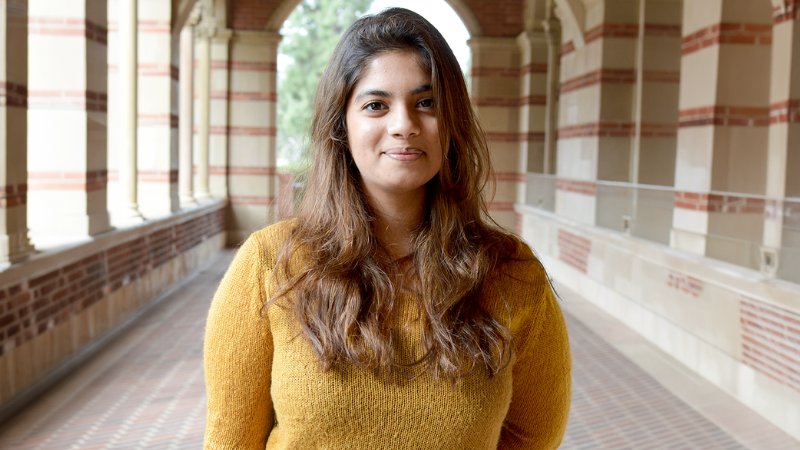
Courtesy of Kshitija Shah
UCLA Samueli Newsroom
Kshitija Shah ’19, M.S. ‘21, Ph.D. ‘25 was nine years old when she started an environmental protection club at her elementary school in Mumbai, India. Like other developing cities, Mumbai was urbanizing rapidly, and with it came disparities between the haves and have-nots.
“Access to potable water was reserved for those who could afford it,” she said. “Whereas that should be a right to all.” In high school, she interned at water and wastewater treatment facilities and ran her first full experiment by age 16.
Shah’s increasing awareness of such environmental challenges, especially around water pollution and waste, shaped her curiosity. She was also heavily influenced by her grandfather, who had a Ph.D. in chemical engineering and was an expert in the water field.
“I was drawn to understanding how we could build systems that are both economically viable and environmentally sustainable,” Shah said. “I knew I needed to have a strong technical educational background.”
When it came time to choose a university, UCLA stood out from other schools with its emphasis on interdisciplinary science and its culture of innovation. But what caught Shah’s attention was the lab of Shaily Mahendra, a professor of civil and environmental engineering at the UCLA Samueli School of Engineering whose work on bioremediation, the use of living organisms to break down pollutants, mirrored the kind of science Shah planned to study one day.
Instead of engineering, however, Shah chose to major in biochemistry when she arrived at UCLA in 2015, convinced it would help her understand biological systems at a fundamental level.
“If I didn’t understand how things worked at the molecular level, how would I be able to apply myself to actually solve problems?” she said.
By her second year, Shah had joined Mahendra’s lab as an undergraduate research assistant, working alongside graduate students on studying the abilities of fungal systems and enzymes to break down a long list of pollutants, including pharmaceuticals, dyes, petroleum compounds and industrial chemicals.
After getting her bachelor’s degree in 2019, Shah returned to Mumbai, interning and then working at Chembond Chemicals. The experience helped her better understand the environmental challenges she had observed growing up. It also confirmed her decision to pursue an advanced degree in environmental engineering and to rejoin Mahendra’s lab.
“Wastewater is no longer just waste, it’s a resource,” said Kshitija Shah. “The most urgent challenge requires rethinking how we recover value from it.”
Not knowing whether she wanted to get a master’s or doctoral degree, Shah was advised by Mahendra to start with a master’s to see if she would enjoy the coursework before petitioning to apply for the doctoral program, which was exactly what she did. She finished her Ph.D. candidacy exam at the end of her first year as a master’s student.
While the shift from biochemistry appeared significant, Shah said her undergraduate training helped shape her approach to environmental engineering.
“Engineering is just applied science,” Shah said. “I was able to apply fundamental, interdisciplinary science to building and engineering systems that solved tangible problems in the real world.”
Her doctoral research focused on how fungi, microalgae and bacteria respond to environmental contaminants at the molecular level. She studied per- and polyfluoroalkyl substances, the forever chemicals known as PFAS that are linked to cancer. Conventional methods of removing these chemicals from the environment are expensive and energy-intensive, while biological approaches offer a more sustainable, albeit slower alternative. She was also part of a team that developed a combined bacterial-algal system for wastewater treatment, designed to use less energy than it produces while capturing carbon dioxide in the process. The system is modular, allowing it to integrate into existing treatment plants or operating independently in areas without infrastructure.
Shah’s work brought together collaborators across disciplines, including microbiologists, membrane scientists, process engineers, public health researchers and analytical chemists. Getting them to understand one another took some efforts.
“My lab mates and I spoke microbiology, and our colleagues spoke membrane science and process engineering,” Shah said. “Learning how to develop a system and explain microbial needs during the system design took multiple iterations over many years.”
But the experience also reinforced her view that modern scientific challenges require collaborative, interdisciplinary approaches.
Outside the lab, Shah served as co-president of the Graduate Society of Women Engineers at UCLA and worked in external affairs for her department’s graduate student association. She was also a facilitator for the Program for Excellence in Education and Research in the Sciences, or PEERS, a UCLA enrichment program designed to support students in the fields of science, technology, engineering and mathematics.
During her time as a Bruin, Shah built a steady following on Instagram, where she posted about what it’s like to pursue a Ph.D., from taking candidacy exams to being an international student and a woman of color in STEM. The motivation, she said, came from her own initial confusion. She suspected she wasn’t the only one.
“For so long, academia has been exclusive,” Shah said. “If I can help answer even one person’s questions about academic research, I can make it a more inclusive space.”
After completing her Ph.D. in 2025, Shah went back to Chembond Chemicals in Mumbai. She is now working to apply her research to environmental challenges facing developing cities while building partnerships with scientists and industry leaders across India.
“The future of sustainability lies in circular systems, where waste streams are converted into energy, materials or reusable water,” Shah said. “Wastewater is no longer just waste, it’s a resource. The most urgent challenge requires rethinking how we recover value from it.”