
UCLA Engineer Neil Lin Receives $2.1M DOD Grant to Develop AI “Digital Twins” Targeting Treatment-Resistant Prostate Cancer
The project builds on years of groundwork toward personalized care aimed at outsmarting one of cancer’s most stubborn defenses
Mechanobioengineering Lab/UCLA
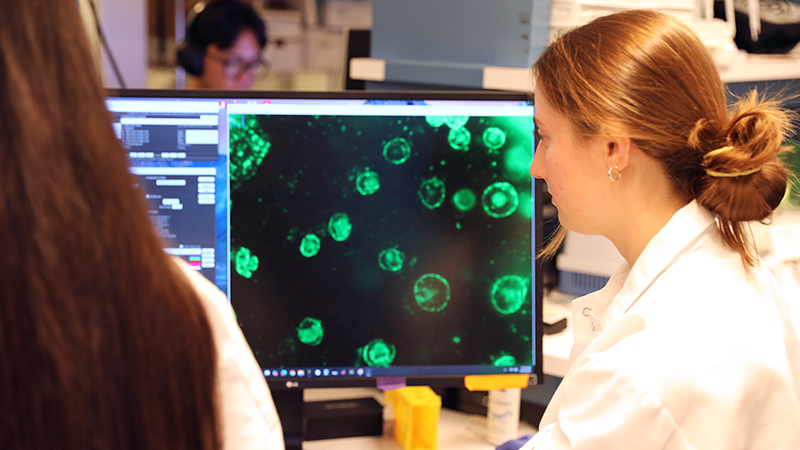
Ph.D. candidate Zoe Latham (right) and postdoctoral scholar Alex Bermudez (left) examine fluorescence microscopy images of the 3D bioengineered tissue models they developed to train and validate the digital twins
UCLA Samueli Newsroom
About 1 in 8 American men will be diagnosed with prostate cancer in their lifetime, and 1 in 44 will die of the disease. While early detection and treatment have cut the mortality rate by about half over the last 30 years, it remains the second-leading cause of cancer death in American men, behind only lung cancer, according to the American Cancer Society. This is largely because late-stage and aggressive forms of prostate cancer are not responding to standard treatments, with a median life expectancy of three years after diagnosis.
To address this challenge, the U.S. Department of Defense has awarded a four-year, $2.1 million grant to a research team led by Neil Lin, an associate professor of mechanical and aerospace engineering and bioengineering at the UCLA Samueli School of Engineering. The funding will support a new approach merging genetic testing, functional drug-sensitivity testing and advanced computer modeling into a single system for guiding prostate cancer therapy.
Lin’s Mechanobioengineering Lab at UCLA Samueli has incorporated advances in AI into its research on cancer screening, diagnosis and treatment strategies. The group has also developed 3D tissue-engineering platforms to better assess potential therapies.
The new grant will support his team’s work in precision medicine, combining genetic analysis with drug-sensitivity testing to identify treatments tailored to individual patients. The researchers will aim to better understand the relationship between a tumor’s genetic profile and its response to different drugs and use that information to guide treatment.
Building “Digital Twins” to Outsmart Resistant Prostate Cancer
First, the team will use an AI platform to build large language model-based “digital twins” of prostate tumors, combining detailed genetic information with functional testing of tumor models. These computer models will then analyze the biological pathways driving each tumor and simulate how different treatments might affect it, helping researchers identify potential patient-specific therapy strategies.
The researchers will pay particular attention to tumors carrying a mutation in the BRCA2 gene, the same gene linked to hereditary breast and ovarian cancer, which is associated with more aggressive, treatment-resistant prostate cancer. The team will design specialized drug-testing panels aimed at identifying combination therapies most likely to be effective against such tumors.
To power these predictions, the researchers will use automated, high-throughput testing on organoids — small 3D models grown from cells extracted from a patient’s own tumor. Exposing these organoids to a range of prostate cancer drugs allows the team to measure how each tumor responds and uncover the specific mechanisms it uses to resist treatment.
Finally, before any drug combination advances toward clinical trials, the team will run it through a computational safety and feasibility check, modeling how the drugs would behave and interact inside the body, not just in a lab dish.
“For patients with aggressive, treatment-resistant prostate cancer, time and biology are both working against them,” said Lin, who holds a joint faculty appointment in urology at the David Geffen School of Medicine at UCLA. “By pairing genetic sequencing with how a patient’s own tumor responds to drugs, we can build digital twins that point to therapies grounded in the tumor’s actual biology. Our goal is to have this validated and ready to advance into clinical trials within four years.”
Building on Six Years of Collaborative Research
The multidisciplinary UCLA team includes Lin’s longtime collaborator Andrew Goldstein, an associate professor of molecular, cell and developmental biology and urology at the Geffen School of Medicine and an expert in prostate cell development and the biological signals that drive cancers. Since 2020, the duo has built the organoid and computational platforms this project depends on, including patient-derived prostate organoid models and AI-guided mechanistic studies. Their partnership has resulted in co-authored publications, jointly mentored trainees and the development of organoid models that serve as the foundation for this new work.
Other researchers working on this project include Robert Damoiseaux, a professor of molecular and medical pharmacology with a joint appointment in bioengineering, and John Lee, a physician and associate professor-in-residence of hematology and oncology and urology. Lin and Damoiseaux are both faculty members of the Jonsson Comprehensive Cancer Center and the Broad Stem Cell Research Center. Lin is also a member of the California NanoSystems Institute and the Institute for Quantitative and Computational Biosciences at UCLA.
In 2022, Lin received the Prostate Cancer Foundation Young Investigator Award for developing a 3D bioengineering platform to study the exchange of nutrients between prostate cancer cells and their environment. He also received the Maximizing Investigators’ Research Award that year from the National Institute of General Medical Sciences, which supported his earlier studies on cell rejuvenation and helped lay the foundation for the current work.