
UCLA Chemical Engineers Launch Pilot Project to Turn Campus Waste into Hydrogen Fuel
The collaboration with climate tech company Mote will help advance the university’s sustainability goals
Mote
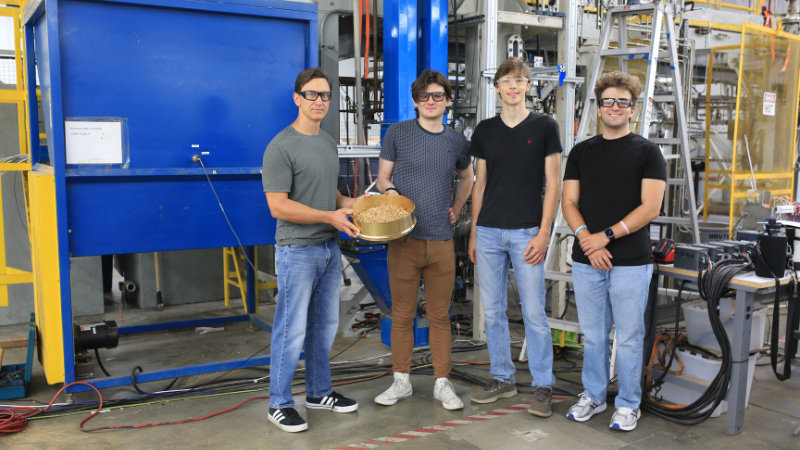
From left to right: Dante Simonetti with graduate students James Kasten, Alex Geldmeyer and Vagelis Christofides, holding wood chips that will be converted into hydrogen at Mote’s biomass gasification plant in Los Angeles
UCLA Samueli Newsroom
Researchers at the UCLA Samueli School of Engineering are collaborating with industry partner Mote to transform biomass waste on campus into hydrogen fuel while removing and sequestering carbon dioxide.
Led by Dante Simonetti, an associate professor of chemical and biomolecular engineering at UCLA Samueli, the team has been working since April to test and evaluate a pilot-scale biomass gasification system with three key objectives: carbon removal, waste reduction and clean energy production.
The process could turn UCLA’s biomass waste — approximately 7 tons per day of materials including food waste and plant trimmings — into hydrogen gas while capturing carbon dioxide released during the process before it escapes into the atmosphere.
The team estimates that the resulting hydrogen could generate enough power to meet about 2% of UCLA’s total electricity needs or serve as an on-demand energy source during peak periods for several hundred hours each year. Alternatively, the hydrogen produced could fuel approximately 100 hydrogen vehicles, supporting clean transportation at UCLA.
By producing high-purity hydrogen rather than syngas, the researchers aim to improve on similar biomass gasification processes used elsewhere. Hydrogen has a higher energy content by mass than syngas and allows for greater flexibility in how it can be used, such as powering fuel cells, fueling hydrogen vehicles and supporting industrial applications. Combined with carbon capture, the approach has the potential to also remove carbon dioxide from the air, maximizing the environmental benefits of biomass gasification.
The research is supported by Mote, a climate technology company headquartered in Los Angeles that has developed a process to remove carbon and generate hydrogen from woody biomass, including urban green waste and residues from California wildfire-prevention efforts. The current project combines Mote’s gasification platform and pilot-scale technology with UCLA Samueli’s expertise in catalytic processes, systems engineering and sustainability-focused research.
Mote
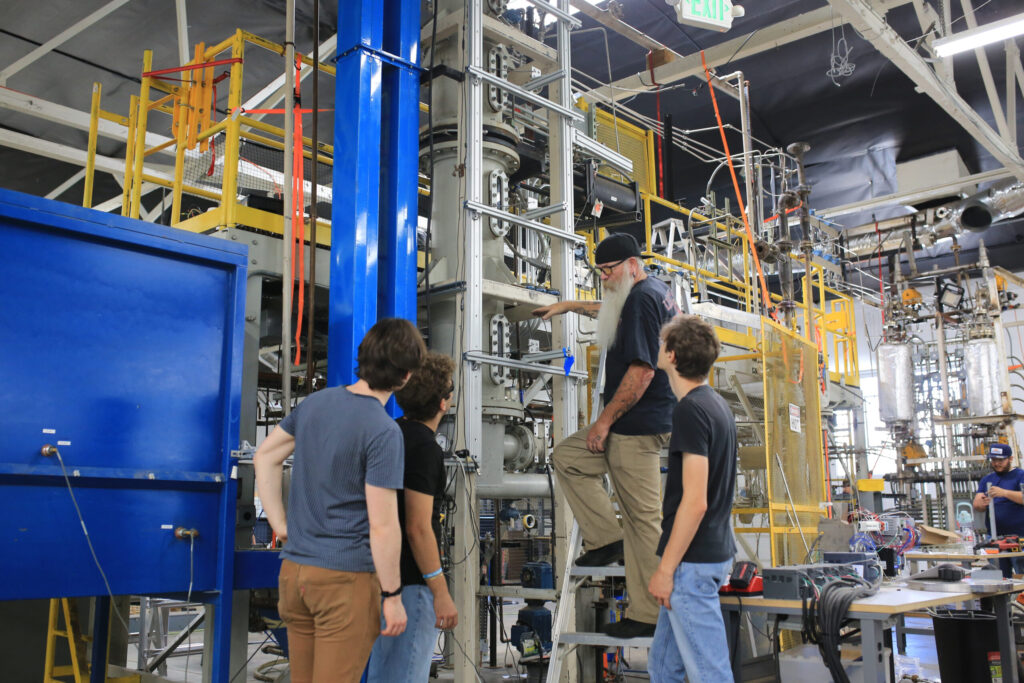
Mote process engineer Robert Knight explains how wood chips are fed into a gasifier to UCLA graduate students
“This joint effort provides a unique opportunity for our students and researchers to work at the intersection of fundamental science and real-world application,” said Simonetti, who serves as vice chair for undergraduate education in the Chemical and Biomolecular Engineering Department. “By partnering with Mote, we can accelerate the development of technologies that convert waste streams into clean energy while training the next generation of engineers and innovators.”
Simonetti, whose research focuses on catalytic reaction engineering and energy systems, will lead technical investigations into feedstock behavior, process optimization and overall system performance. The project also provides hands-on opportunities for graduate and undergraduate students to work directly with emerging decarbonization technologies.
The 18-month pilot project is scheduled to run through September 2027, with the possibility of an extension and $100,000 from Mote to support stipends, tuition and research supplies for two UCLA Samueli chemical engineering graduate students.
“This collaboration reflects the power of pairing innovative climate technology with world-class research institutions,” said Joshuah Stolaroff, CEO and co-founder of Mote. “UCLA Samueli brings deep expertise and a strong commitment to sustainability, making it an ideal partner as we continue to refine and scale our bioenergy and carbon removal platform.”
The team is working with UCLA Sustainability to coordinate the effort with campus and local partners to ensure it aligns closely with the university’s long-term sustainability goals.
“The technology has the potential to reduce campus waste, displace fossil fuel-based energy sources and power clean transportation,” Simonetti said. “It also strengthens UCLA’s role as a living laboratory by demonstrating technologies that could be replicated across the University of California and beyond.”