
Q&A with Dr. Benjamin Cowan B.S. ‘67, M.D. ‘75
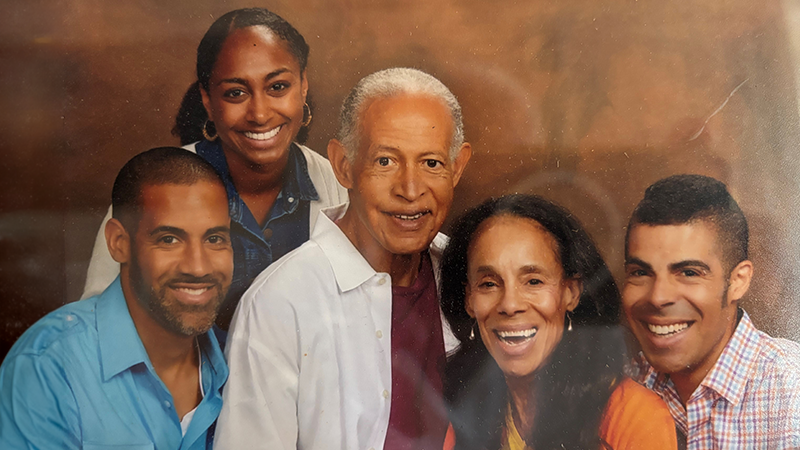
Courtesy of Cowan family
From left to right: Christopher Cowan, Dr. Monica Soni, (Christopher’s wife), Dr. Benjamin F. Cowan, Dr. Lettie M. Burgett, and Benjamin (Benji) Cowan.
Dr. Benjamin F. Cowan B.S. ’67, M.D. ’75, born in Chicago and raised in Mississippi, built a distinguished five‑decade career as a diagnostic radiologist in Los Alamitos, California. Prior to entering the medical profession, he was an engineer with a promising career.
Dr. Cowan graduated from the UCLA Samueli School of Engineering with his bachelor’s degree in 1967. While attending UCLA, he had the rare opportunity to study under the school’s founding dean, L.M.K. Boelter, an experience that left a deep and lasting mark on him. The curriculum demanded independence, intellectual discipline, and the ability to break down complex problems from multiple angles simultaneously. Just as importantly, UCLA exposed him to people from many backgrounds and perspectives, teaching him that not every challenge yields to formulas alone; some require empathy, imagination, or a completely different way of seeing the world. Those lessons extended far beyond engineering and ultimately helped guide him toward medicine, a path that led him back to UCLA to earn his medical degree in 1975.
After completing his internship and residency in diagnostic radiology at Harbor-UCLA Medical Center, he worked at several hospitals before becoming a member of the radiology staff at Los Alamitos Medical Center. Known for his meticulous eye and steady clinical judgment, he provided essential diagnostic insight across a wide range of medical conditions and became a trusted partner to physicians throughout the region. Board certified in diagnostic radiology, Dr. Cowan embraced the rapid evolution of imaging technology, from traditional film to advanced digital systems. After decades of service, he recently retired from active clinical practice, concluding a career defined by dedication, expertise, and a deep commitment to his community.
Beyond his professional accomplishments, Dr. Cowan’s life has been defined by family. He was the loving husband of Dr. Lettie M. Burgett, a respected physician in her own right, who passed away in 2022. Their partnership — both personal and intellectual — was a cornerstone of his life. Together, they raised two sons, Benji and Christopher Cowan. Dr. Cowan takes great pride in being a devoted father and grandfather.
Dr. Cowan’s legacy of service continues with the Dr. Lettie M. Burgett and Dr. Benjamin F. Cowan Scholarship in Engineering, and the Dr. Lettie M. Burgett and Dr. Benjamin F. Cowan Endowed Medical Student Scholarship at the David Geffen School of Medicine at UCLA.
“UCLA taught me independence, discipline, and how to approach complex problems from multiple angles. It also exposed me to people from diverse backgrounds, which broadened my worldview and helped me understand that not every challenge is solved with equations — sometimes you need empathy, creativity, or a different lens entirely.”
Q: Please share a little bit about your background. Tell us about yourself, and your journey to UCLA.
A: My journey to UCLA began far from Los Angeles. I was born in Chicago, where my mother had moved as part of the Great Migration in search of better opportunities. When we eventually returned to Natchez, Mississippi, because the promise of a better life and job opportunities were not realized in Chicago, I found myself navigating a world where education was both a privilege and a lifeline. I was fortunate to have excellent teachers in science, mathematics, and history.
I enrolled at Tougaloo College in Jackson, Mississippi, an HBCU [Historically Black colleges and universities] whose name, Choctaw [a native American language] for “between two streams,” was reflected in the sense of possibility I felt there. It was a beautiful, nurturing place, but even then, the cost of room, board, and tuition — $720 a year — was a significant barrier for my family. My cousin paid for my first year, but I knew I had to find a more affordable way to continue my education. Following my mother’s advice to “do what you have to do,” I moved across the country to Los Angeles to live with my aunt and pursue the dream of attending the UCLA School of Engineering.
Q: Why did you choose to pursue your B.S. at UCLA Samueli? What drew you to UCLA specifically?
A: UCLA had a stellar reputation and, for a young man with limited financial resources, it was also affordable. That combination mattered. I arrived in Los Angeles in June 1962, and on my second day, my aunt and I took a bus from the Crenshaw area to campus so I could take the first step to transfer to UCLA. Without an appointment, we were welcomed into the office of Dr. Llewellyn M.K. Boelter, the founding dean of the School of Engineering. He spoke to us with kindness and practicality — a moment of generosity and guidance that stayed with me and nurtured my confidence as a student.
Knowing the financial challenge I was facing, Dr. Boelter advised me to consider attending Los Angeles City College for the first two years to help me with the cost of college education. I took his advice and continued my studies there before transferring to UCLA School of Engineering and graduating in 1967.
Of course, I had no idea at the time that Dr. Boelter, an unassuming man, was one of the great figures of modern engineering — a pioneer whose name lives on in the Dittus–Boelter equation, a foundation of convective heat transfer analysis. He was also the first Dean of Engineering at UCLA, guiding the school from 1944 to 1965 and shaping it into a true school of engineering rather than a collection of isolated departments. He pushed for collaboration long before it was fashionable.
Q: How did your time as an engineering student at UCLA shape your life and career path?
A: UCLA taught me independence, discipline, and how to approach complex problems from multiple angles. It also exposed me to people from diverse backgrounds, which broadened my worldview and helped me understand that not every challenge is solved with equations — sometimes you need empathy, creativity, or a different lens entirely. Those lessons stayed with me far beyond engineering — they opened a path that ultimately led me to earn my medical degree from UCLA in 1975.
Q: Is that where you met your wife, Dr. Lettie M. Burgett?
A: Indeed, I have UCLA to thank for meeting my wife, Lettie. We were both interns at Harbor-UCLA Medical Center. We always laughed about how we met. I was at the hospital waiting for the elevator and when its doors finally opened, she was standing there in front of me. I was mesmerized and followed her to the cafeteria. We were meant to be together.
Lettie had her own remarkable path. She grew up in St. Louis and knew from childhood that she wanted to be a pediatrician — inspired by the early mentorship she received from her own pediatrician. She attended University of Rochester where she studied biology and went on to Harvard Medical School. Keep in mind, she was one of just five African American women out of a class of 150 students. She practiced medicine at a time when there were only a handful of African American doctors in the country, and even fewer African American women. She was extraordinary — brilliant, disciplined, and driven — but what defined her most was her kindness. She loved her patients, and they loved her in return.
Q: You and your wife built your careers around caring for others. As you reflect on your years practicing medicine, what inspired you to establish the Dr. Lettie M. Burgett and Dr. Benjamin F. Cowan Scholarship in Engineering?
A: Together, our lives were built on the belief that mentorship and education open doors – and that those doors should be accessible to everyone. We pursued medicine — Lettie in pediatrics and I in diagnostic radiology — because we loved helping people. We knew that pursuing challenging careers like medicine and engineering requires more than passion. It required hard work, learning to collaborate with colleagues, and yes, financial support. We were fortunate to find our way, but many talented students face financial barriers that limit their potential.
The goal of this scholarship is simple: to help students pursue their dreams without being held back by cost. It is also a tribute to Lettie. A scholarship with her name feels deeply fitting.
Q: What do you hope this scholarship helps students achieve academically, personally, and professionally? What kind of legacy would you like it to leave?
A: I hope this scholarship eases financial stress so students can focus on learning, discovery, and creating ways for their engineering education to shape the future. My deeper hope is that recipients will one day be able to help others in the same way. If this scholarship creates a ripple effect of generosity and opportunity, that would be a legacy worth leaving.