
In Conversation with Vinita Gupta, First Woman of Indian Origin to Take a U.S. Company Public
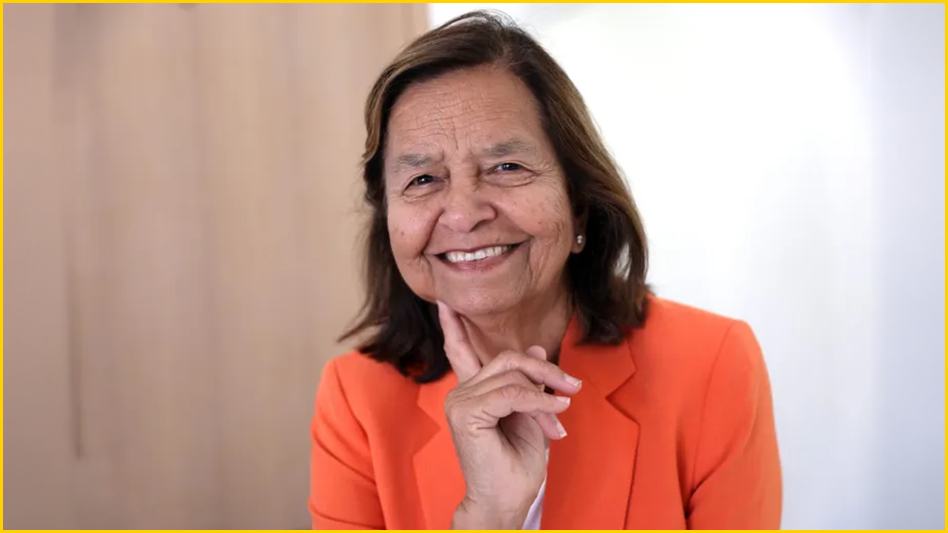
Born and raised in India, Vinita Gupta M.S. ’74 earned her bachelor’s degree in electronics and communications engineering from the Indian Institute of Technology Roorkee in 1973 before coming to the U.S. The following year, she became the only woman in her class to graduate from UCLA with a master’s degree in electrical engineering.
After UCLA, Gupta worked in telecommunications at GTE Lenkurt and Bell Northern Research before launching Digital Link Corporation in 1985. In 1994, she became the first woman of Indian origin to take a company public in the U.S. when Digital Link completed its initial public offering. She continued to serve as chair, president and CEO of the firm, which was later renamed Quick Eagle Networks, until her retirement around 2016. She holds two U.S. patents and published a memoir last fall chronicling her journey from India to the U.S. and her experiences as an innovator and entrepreneur.
On May 19, at the invitation of the Women Advancing Technology Through Teamwork (WATT) at UCLA, a student group operating as a branch of the Institute of Electrical and Electronics Engineers, Gupta returned to her alma mater at the UCLA Samueli School of Engineering for a fireside chat with faculty and students in the Engineering IV building. She was joined by Ronald and Valerie Sugar Dean Ah-Hyung “Alissa” Park and fourth-year electrical engineering student and WATT president Katie Wang.
Following are highlights from the conversation, with modifications for brevity and clarity.
“You put one foot in front of the other, knock down each problem as it pops up, and one day you may emerge a winner,” said Vinita Gupta.
Q: You took a winding path to where you are. How did your mindset change along the way?
A: Looking back, being adaptable was my biggest asset — and being an engineer was a plus, no matter what business you go into. I never had a particular mindset beyond knowing I wouldn’t be satisfied unless I was doing better than the people around me. You measure yourself against those you consider your equals, and once you start to emerge from that group, you meet a new set of people and the bar moves again.
I went from engineer to inventor — the patents were unusual with just a master’s degree, because patent work is almost like research and most people don’t think they’re capable of it. Then you discover you’ve done something no one has done before you, and that’s an energizing, confidence-building milestone. From being an inventor, I became a founder, and two things stand out about being an entrepreneur. First, you always have the monkey on your back: if things go right, the credit is yours; if they go wrong, the fault is yours. Once you accept that, you give it your best shot, because there’s no one else to blame. Second, you have to be an ace problem-solver — you’re constantly solving problems, and it keeps you sharp.
Q: You are the first woman of Indian origin to take a company public in the U.S. What does that milestone mean to you?
A: The milestones are good to have. But very soon after that, you say, “What is the next milestone?” When you’re hiking, you get to a place to rest, and you take a deep breath. That’s how I think of milestones. But then you go on the next trek. When we were going public, it was a process and a learning curve. There was a lot at stake. Once the IPO was done, it was about solving all the other problems that were brewing. If you’re a problem-solver, you would love to be an entrepreneur. We are constantly progressing.
Q: We can often forget about all the difficult setbacks we encounter on our career paths. What kept you going on your journey?
A: The proverb is that the journey is the reward. You don’t work for milestones; you work for the journey. You have to enjoy at least parts of it — you can’t always be on a treadmill, because that gets old quickly. What energizes me is learning. If I learn something new, I’m happy even if I fail. If I succeed but haven’t learned anything over a long stretch, it isn’t satisfying. As I moved through different chapters, from entrepreneur to author, I wasn’t naturally gifted at any of them. I just worked hard.
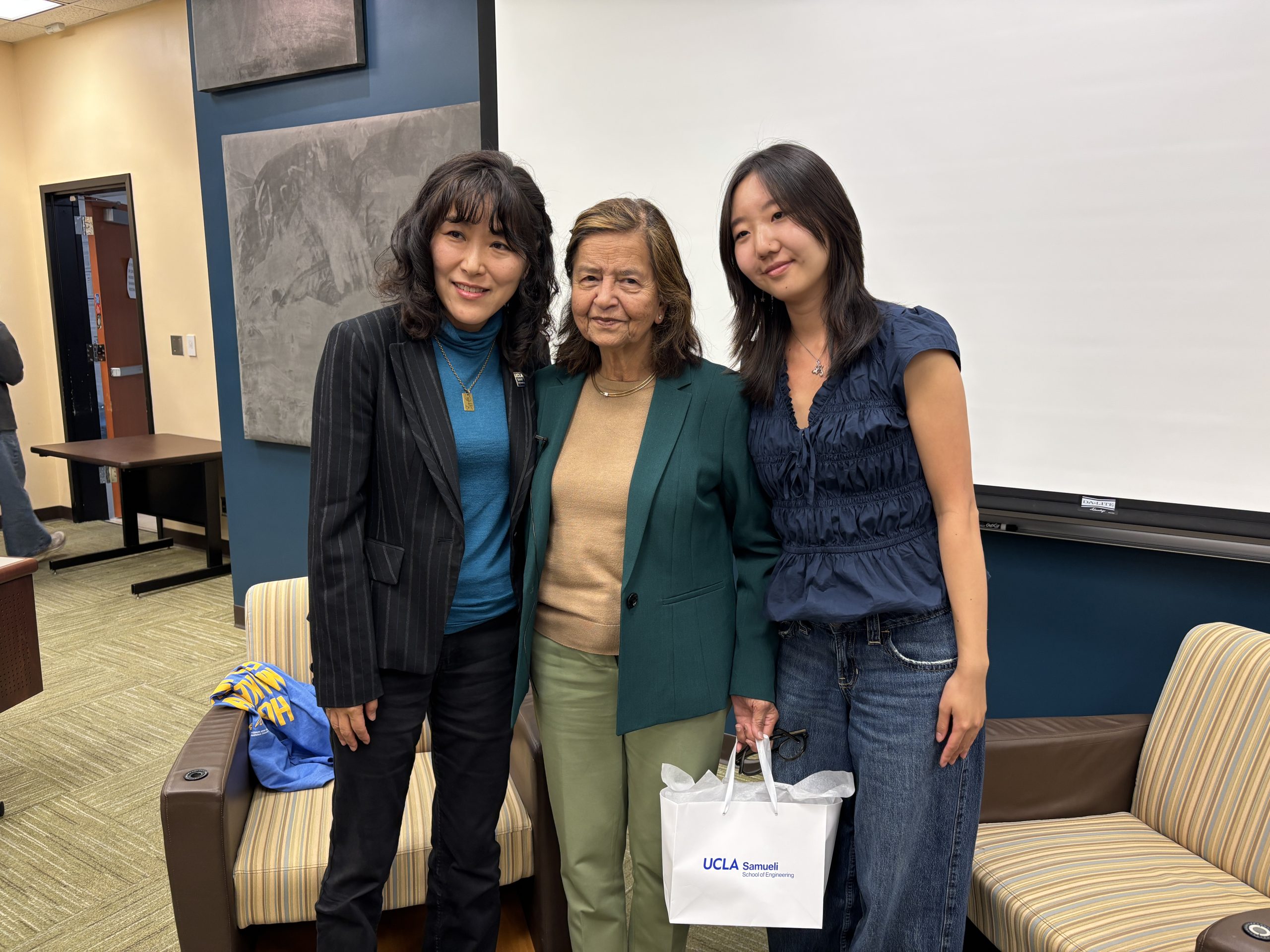
Vinita Gupta (center) with UCLA Samueli Dean Alissa Park (left) and fourth-year electrical engineering student Katie Wang (right)
Q: Engineering can help you learn how to learn. In what ways do you continue to push and learn on your own?
A: Today, I walked by Pauley Pavilion and went to the gift shop. I bought a shirt with such a practical message on it. It’s a quote from John Wooden: “Hustle makes up for many a mistake.” It’s all about how you move forward. There is learning everywhere. Our brain misfires so many times. Forgive yourself for the mistakes you make. If you keep regretting your mistakes, you’ll make more. Learning comes from many different directions for me. It doesn’t have to be engineering, it can be in any sphere, including writing.
Q: For students and faculty thinking about their own startups, if you could bet on one technology to make a huge impact over the next 10 or 20 years, what would it be?
A: I wish I knew the answer. But you have to bet on a number of companies, not just a technology, because it’s also about execution — how agile the founders are and the culture they build. I tell students: if you’re going to open a dry-cleaning shop, work in one first, so you know what to expect. Go in cold, and the early problems can overwhelm you. As an entrepreneur you end up learning five disciplines you’d never touch at a large company — finance, manufacturing, marketing, sales — while leading the whole thing. It’s continuous: You put one foot in front of the other, knock down each problem as it pops up, and one day you may emerge a winner.
Q: What early-career choices would you advise students to make, and what do you think they worry about too much?
A: Work for another company first and learn on someone else’s dime. Don’t start a company right out of school. There are exceptions — Sam Altman left school and started one — but those are few and far between. Working elsewhere first gives you a broader landscape to choose from. Whatever you choose, treat it as the right thing and stick with it, unless you can clearly see there’s no future there. But don’t wait forever, either. When you’re psychologically ready to start a company, you’ll know — there’s no written test for it. When you know, do it.
Q: How would you recommend building a good relationship with mentors?
A: A mentee often feels they’re the one seeking and the mentor is the one providing answers. But every interaction has to be two-way. You have to believe you’re also offering something — you don’t have to know exactly what, but you have to believe you’re capable of contributing. Take venture capitalists: when you go to raise money, you think you’re the one asking, but they meet with many entrepreneurs because that’s how they learn what technologies are emerging. Many entrepreneurs think they’re the takers and the VCs are the givers, and that conversation doesn’t work well. If you understand that they’re getting something too, you’ll talk to them as equals — and equal-level conversations are always more productive.