
From UCLA to Microsoft: A Bruin Computer Scientist Surfing Two Decades of Tech Waves
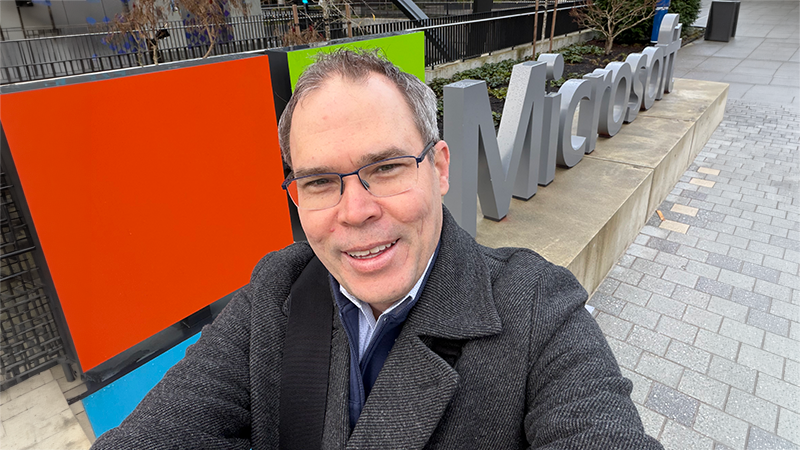
Courtesy of Adam Harmetz
UCLA Samueli Newsroom
At Adam Harmetz’s childhood home in San Diego, the rules were simple. Video game consoles were not allowed. If he wanted to play, he had to learn to use a computer.
Harmetz’s parents — his father, a dentist and UCLA alum, and his mother, an educator — made sure he was exposed to computers early, giving him an Apple and later a Compaq computer. Now a vice president of product at Microsoft, Harmetz credits them with nurturing his interest in computers.
“I was part of the first 1% of humanity to use the internet,” Harmetz said. “It was such a lucky gift of a lifetime to be exposed in those formative years to something so world changing.”
Over the past two decades, Harmetz has helped build Microsoft’s content and collaboration platforms, including Microsoft 365 — a suite of applications such as Word, Excel, Teams and Outlook, now augmented with the AI assistant Copilot. He manages a team of roughly 100 product managers, data scientists and customer success experts across the U.S., Europe, India and China, supporting services such as OneDrive and SharePoint, which process billions of pieces of user content daily.
It’s a role shaped in part by his time at UCLA, where he double majored in computer science and business economics after starting college without declaring a major. Following a summer internship coding with the Office of Naval Research, Harmetz realized that while he enjoyed writing code, that’s not all he wanted to do.
“I loved the creative process of design and the business aspects of building something economically viable,” said Harmetz, whose double major afforded him the opportunity to be in both fields.
He still vividly remembers the day one of his computer science professors finished explaining how transistors, the electronic switches that help power computers, worked. For the first time, Harmetz said he felt he understood the full stack, from hardware fundamentals to high-level programming languages. It’s a moment that sticks with him to this day, as he strives to make the best decisions in the face of increasingly complex technology.
“You have to understand the layers underneath you and empathize with the engineers who made tradeoffs in them,” Harmetz said. “I don’t use my knowledge of transistors every day, but it taught me how to think and gave me the confidence that I know how the entire system works.”
“What’s kept me ahead in my career is the ability to figure out what change is coming and be proactive about evolving myself, my team and my product for the next wave,” said Adam Harmetz. “This is why I’m so thankful for UCLA for teaching me not just what to do, but how to think.”
Outside the classroom, Harmetz immersed himself in student life. He served in the Undergraduate Students Association Council, worked as a resident assistant, participated in the UCLA chapter of the Association for Computer Machinery and volunteered with a tax-preparation program.
He came to see UCLA as a microcosm of the real world, where he could experiment by participating in student government, clubs and volunteer groups.
“It was a wonderful playground to try out the type of leader I wanted to be,” Harmetz said. “I learned how to build coalitions, clearly communicate with others and find my passions.”
Harmetz graduated summa cum laude in 2005 and joined Microsoft as a program manager on Microsoft Office. He has remained with the company ever since, an increasingly rare path in the tech industry.
Over the years, Harmetz has worked through successive waves of change, from web and mobile to cloud computing. He said the current shift toward artificial intelligence is the most significant yet.
“Never before has there been a shift that has gotten as much societal attention or executive attention,” he said. “It’s not just a technology shift, but a shift to the production function of many industries, especially my own. It’s like building an airplane while flying it.”
Today, Harmetz focuses on building what he calls “agentic harnesses,” systems that use AI models to draw on the context embedded in an organization’s documents and conversations. Given the scale of the platforms his team oversees, he sees his role as helping people and organizations unlock and apply their own data more effectively.
Outside his work at Microsoft, Harmetz co-writes Mind the Beet with his wife, Helen, whom he met at UCLA while she was studying political science. The email newsletter has more than 1,000 subscribers and features the couple’s insights on product development and careers in tech. His most-read post argues that careers are better likened to surfing waves than climbing a ladder.
The challenge, he writes, is recognizing which waves are worth catching — a skill built through experimentation, side projects and experiences that may seem unproductive at the time but sharpen intuition.
Looking back, Harmetz sees that instinct — recognizing and adapting to change — as the common thread in his career.
“What’s kept me ahead in my career is the ability to figure out what change is coming and be proactive about evolving myself, my team and my product for the next wave,” he said. “This is why I’m so thankful for UCLA for teaching me not just what to do, but how to think.”