
From Slime to Skincare: UCLA Engineering Senior Blends Passion for Chemistry and Communication
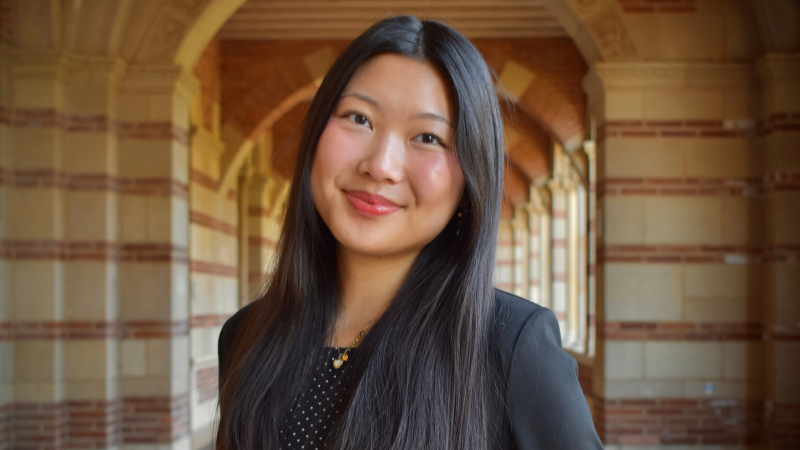
Growing up an only child in the suburbs outside Minneapolis, where there were very few Asian American kids at her school, Nicole Guan said being bored was her first problem to solve. She was a kid who couldn’t stop looking for things to do, so she watched YouTube videos to make her own cosmetics, mixing sugar and oil into a lip exfoliant and testing slime recipes to see how an extra squeeze of shaving cream or a splash of baby oil would change the texture.
“The kitchen counter was my lab bench, and it pointed me toward chemical engineering before I even knew it,” said Guan, now a rising fourth-year chemical engineering student at the UCLA Samueli School of Engineering.
No one in Guan’s family was an engineer, even though her mother told her she should become one. Her parents ran a Chinese restaurant, where Guan spent most afternoons in the back booth with a stack of books, a refillable bowl of cheese wontons and herself as the sole source of entertainment.
She went along with her mother’s suggestion and picked chemical engineering as her major because she had always enjoyed chemistry in school. She also liked that chemical engineering is not boxed into one industry and can be applied almost anywhere. In fact, Guan didn’t know what her passion was until her own struggle with acne.
“Seeing how much using topicals improved my skin health, my confidence and even my mental health made me realize I wanted to make that same kind of impact for other people,” Guan said. The experience got her thinking that she could combine her interest in skincare with her academic pursuits in chemical engineering. “That is when skincare and health solutions came into focus as the place I wanted to put my energy.”
Connecting Skincare, Health and Engineering
As an undergraduate researcher in the Division of Dermatology of the David Geffen School of Medicine at UCLA, Guan studied how acne-associated genes respond to bacteria, inflammatory mediators and antimicrobial peptides, extracting RNA from cell samples and quantifying gene markers to better understand what makes a treatment work.
Guan also joined Aurum Cosmetics UCLA, a student-led organization providing professional development opportunities for careers in the beauty industry. She was part of the group’s social media team and later served as vice president of external affairs and professional committee head before becoming president of Aurum.
As vice president of external affairs, she designed a six-week program that took students through the full product development cycle — from formulation and testing to regulatory review, branding and launch. Students came from different majors, including business, psychology, data science and biochemistry, and completed the program with their own mock skincare product.
“Engineering helps solve the problem, while communication is what makes that solution usable by the person who needs it,” said Nicole Guan.
Noticing that few chemical engineers considered careers in cosmetics, Guan led Aurum in co-hosting an event last spring with the American Institute of Chemical Engineers at UCLA called “Beauty in the Making.” The event paired a cosmetics industry panel with a workshop where students formulated their own lip gloss. One panelist even offered a job opportunity after seeing the group’s interest in the field.
“I saw the room fill with energy,” Guan said. “Students were genuinely excited about a career path they hadn’t considered before.”
This summer, Guan is working as a regulatory affairs intern at Dermalogica, a skincare company based in Carson, California. She supports global product launches, helping oversee safety testing, coordinate regulatory documentation across markets and manage raw material safety data used in audits and international submissions.
Part of Guan’s job is learning what her colleagues call “the dance,” or the complex work of aligning internal teams, regulators and suppliers. She said her chemical engineering training is most useful for understanding what’s inside a formulation and why an ingredient is safe at one concentration and restricted at another.
Building a Bridge Between Technology and People
Outside of her research and professional pursuits, Guan is also passionate about empowering young students interested in pursuing engineering. She has spent three years with the Society of Women Engineers at UCLA, where she is now vice president of internal affairs. One of the group’s flagship events brings more than 150 middle and high school girls to campus for a day of engineering activities.
“I didn’t have much engineering exposure growing up, but I know I would have loved it if I had,” Guan said. “Getting to be that spark for young girls has been one of the most rewarding parts of this experience.”
Allowing herself to try different things without being boxed into a fixed role has helped Guan gain a new perspective on what it means to be an engineer. While engineers are good at solving problems, she says, they must first understand the people they are trying to help and learn to communicate their solutions effectively. Those are two different skills that Guan is striving to master.
“What I’ve learned through my work is that a great engineer is also a translator,” Guan said. “Engineering helps solve the problem, while communication is what makes that solution usable by the person who needs it.”