
First-Gen UCLA Chemical Engineering Student Develops Hydrogels to Help Treat Eczema
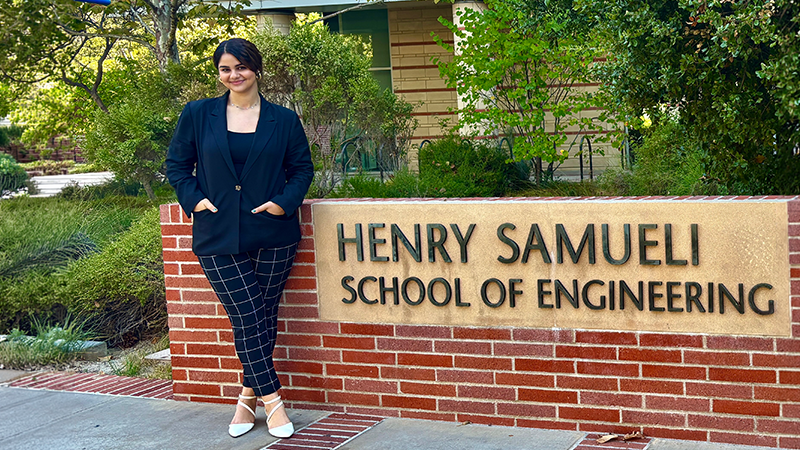
On Bruin Day 2023, Golnaz Moghadam walked out of UCLA’s Parking Structure 4, saw the tree-lined campus and Janss Steps ahead of her and made her college decision on the spot.
“I’m going here,” she remembers blurting out. “It was one of those things that I just knew.”
Now a fourth-year chemical engineering student at the UCLA Samueli School of Engineering, Moghadam is researching skin-compatible hydrogels for eczema treatment. Working in the lab of Thaiesha Wright, an assistant professor of chemical and biomolecular engineering, she is developing biocompatible materials designed to retain moisture.
Despite her affinity for UCLA, adjusting to college proved difficult. Accustomed to excelling in high school, Moghadam struggled with challenging coursework, sometimes finding herself in tears during late-night study sessions at 4 a.m. Still, she stayed determined, attending class and asking questions.
“I accepted that I do belong here, and struggling sometimes does not equal failure or incompetence, but it foreshadows growth and pride,” she said.
A Family’s Sacrifices and the Value of Education
Moghadam grew up in West Covina, California, with parents who immigrated from Iran. They were unable to pursue higher education amid the political upheaval during the 1979 Iranian Revolution and the Iran-Iraq War that followed. A first-generation college student, Moghadam said her parents emphasized the importance of education while they worked hard to provide their children with opportunities in the United States. Her father worked as a truck driver, handyman and mechanic, while her mother raised Moghadam and her siblings.
“The wisdom and positivity my parents continue to instill in me push me to see things from a different perspective,” said Moghadam, who is grateful for her education, health and the many things in life that are often taken for granted. This sense of gratitude has also helped her navigate imposter syndrome and appreciate the opportunities she has had.
“I continue doing hard things even when I am feeling the most discouraged for those who didn’t get the chance to,” said Golnaz Moghadam.
“I continue doing hard things even when I am feeling the most discouraged for those who didn’t get the chance to,” she added.
Proud of her Persian heritage, Moghadam speaks Farsi fluently. She also speaks Spanish and English, and finds her multilingual abilities help her relate to people from different cultural backgrounds. She is also keen on working with children, volunteering as a junior lifeguard at 11 and later working as a lifeguard and swim instructor. She taught 4-year-olds who were afraid to touch the water and, within two weeks, had beginners who could barely kick swimming laps of freestyle.
“Sometimes things we do that are repetitive, such as going to work, don’t seem significant to us, but their impact on others lives on,” she said.
From Chemical Engineering to Skin-Compatible Materials
At UCLA, Moghadam found that chemical engineering suited her curiosity, and she chose to concentrate in biomolecular engineering with a technical breadth in engineering sciences. She joined Wright’s lab her junior year after meeting the professor at an event hosted by Women in Engineering at UCLA. As an undergraduate research assistant, she is part of a team working on developing a micro hydrogel for treating eczema. Eczema can leave skin severely dry, inflamed and irritated, and the team is investigating biocompatible polymers that could help retain moisture on affected skin.
At Wright’s recommendation, Moghadam also participated in the UCLA Samueli Summer Undergraduate Research Program, where she worked with graduate student Christine Tang this summer to synthesize and characterize chitosan-based bulk gels, studying their properties for potential applications on skin. Chitosan is a natural polymer derived from chitin, which is found in crustacean shells. She presented her findings at the program’s poster symposium.
Last summer, Moghadam did an eight-week internship at Connexx Systems Corp. in Kyoto, Japan, through UCLA’s Global Internship Program. She helped fabricate and characterize solid oxide fuel cells for the company’s experimental iron-air energy storage technology. The work showed her that materials rarely behave exactly as theory predicts, and that it is up to engineers to figure out why and how to use them to benefit society. Moghadam says she hopes to pursue a career in biotechnology after graduation.
Outside of her studies and research, Moghadam serves as a peer mentor through UCLA’s chapter of the American Institute of Chemical Engineers and tutors K-12 students in math and science. Having navigated her own challenges at UCLA, she encourages students not to let difficult experiences define their potential.
“The biggest lesson I push on my students is to never let their setbacks blur their future,” she said.