
Engineering Students Develop Community-Owned Rideshare Blueprint in Class Project
Humanities-informed course challenges students to rethink technology’s societal impact
Sergio Carbajo/UCLA
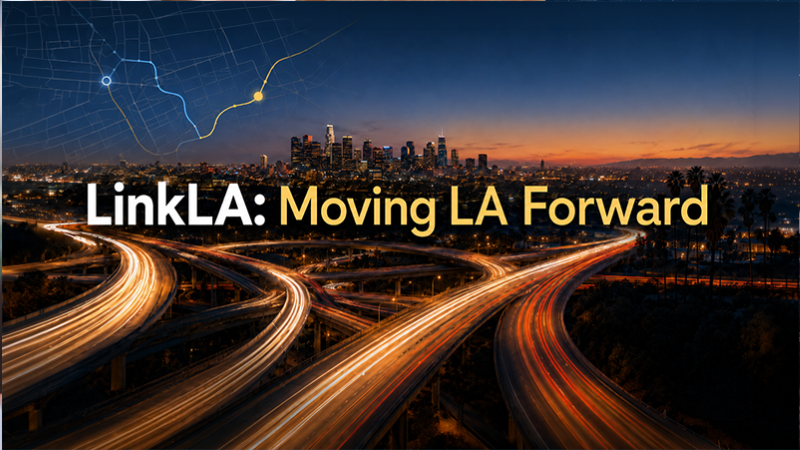
A blueprint for a rideshare app prototype, LinkLA, designed to prioritize drivers and riders while reinvesting profits into public transportation in Los Angeles
UCLA Samueli Newsroom
A group of 13 UCLA Samueli School of Engineering students recently developed a worker-cooperative rideshare model designed to prioritize drivers and riders while reinvesting profits into public transportation in Los Angeles.
In a 17-page blueprint and app prototype for a project called LinkLA, the students proposed changes to existing rideshare systems, including stable hourly wages for drivers, lower fees for riders and more transparent fare structures. A portion of each ride would be directed to a city reinvestment fund supporting public transit, electric vehicle infrastructure and broader mobility programs.
LinkLA was developed as part of ENGR 184: Humanities-Informed Science, Technology, Engineering and Mathematics, a course taught by electrical and computer engineering associate professor Sergio Carbajo. The class emphasizes the role of engineering in shaping society and encourages students to include perspectives from the humanities and social sciences.
“I want students to leave with a fundamentally expanded sense of what it means to be an engineer or scientist — one that recognizes technology is not neutral, and it is important to build comfort with critical thinking and ambiguity rather than just optimization,” Carbajo said. “It is equally important to develop an awareness of how systems of power shape scientific practice.”
The proposed model also reshapes how revenue is distributed. While major rideshare platforms, such as Uber and Lyft, can take up to 30% of a fare, LinkLA allocates only 15% to operational costs, with 6.5% directed to a city reinvestment fund and 5.5% reserved for emergency funding.
Driver compensation is another key difference. Under LinkLA’s worker-cooperative model, drivers would earn an hourly minimum wage as employees, rather than per-ride pay as independent contractors. As members, drivers would also have voting power on key governance decisions.
“You can see every day how challenging transportation can be in Los Angeles, especially for people who don’t have cars,” said Samantha Redifer, a third-year computer engineering student who worked on the project. “We wanted to ask, what if rideshare actually worked for the city instead of extracting from it?”
The proposal also outlines ride-matching algorithms based on proximity and feasibility rather than personal data. Governance policies would limit data collection and prohibit surveillance-based monetization practices such as surge pricing.
While the students are not currently planning to launch LinkLA, their blueprint outlines an implementation roadmap, including engagement with LA Metro and community town halls to gather input.
Redifer said one of the takeaways from the class was the importance of not getting caught up in technical details and losing sight of societal impact.
Now in its third year, ENGR 184 has continued to grow in enrollment. Students begin by studying foundational frameworks, such as sociotechnical systems theory, before applying those frameworks to group projects based on shared interests.
The course, which satisfies the engineering ethics requirement, connects technical design with policy and governance. Past projects have explored topics including non-extractive artificial intelligence systems, alternatives to surveillance infrastructure and energy systems informed by Indigenous and ecological perspectives.
“Looking forward, I hope this class contributes to a shift in which ethics is no longer treated as a standalone requirement but is meaningfully integrated across STEM curricula,” Carbajo said. “Students should be trained not only to build systems, but also to question and redesign them.”