
Electrical Engineering Undergrad Builds Award-Winning Remote Platform to Expand Access to Hands-On Learning
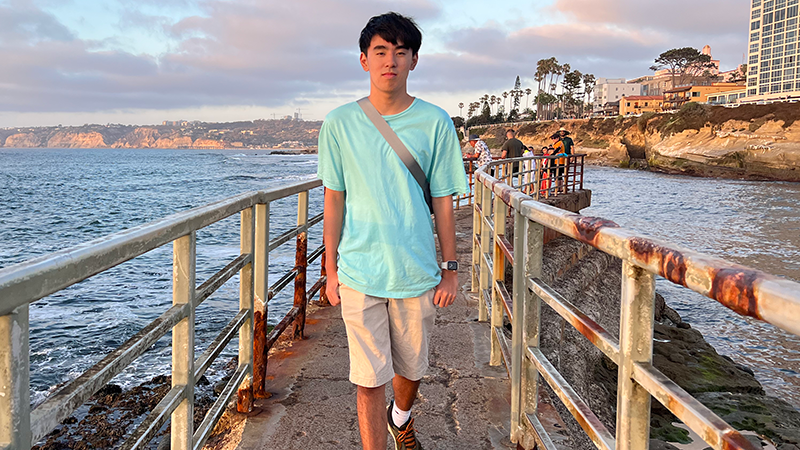
Courtesy of Ethan Ge
UCLA Samueli Newsroom
The summer after ninth grade, the air conditioner in Ethan Ge’s house in Riverside, California, gave out. He opened it up, traced the issue to a failed capacitor and replaced it. The unit hummed back to life. It was the first time Ge understood how his technical knowledge could solve a real problem.
Now a third-year electrical engineering student at the UCLA Samueli School of Engineering, Ge has continued to put his skills to work, building a tool to improve the student experience and expand access to hands-on learning.
Ge developed RemoteRF, a Python-based platform that lets students remotely interface with software-defined radios (SDRs) over UCLA’s network. SDRs are systems whose behavior is controlled largely through software rather than fixed hardware, making them flexible tools for applications ranging from secure communication to monitoring satellites and wireless prototyping.
Until recently, working with SDRs required purchasing expensive personal devices, checking out limited inventory or scheduling time in a physical lab. RemoteRF removes those barriers by allowing students to write and run code on their own laptops while connecting to shared SDR hardware housed in a lab environment. The platform is now used in three UCLA courses: ECE 132A, ECE 239AS and ECE 230B.
“RemoteRF was never just a technical project to me,” Ge said. “It was also about access, equity and creating opportunities for students who might not otherwise get hands-on experience with this kind of technology.”
The platform has been well received by both students and instructors, in part because it integrates seamlessly with existing coursework. Rather than replacing traditional lab work, RemoteRF preserves the interaction with real hardware while removing the constraints of lab space, scheduling and availability.
For the project, Ge received a UCLA Internet Research Initiative prize for the 2025–26 academic year, which includes a $7,000 stipend. The initiative, which supports undergraduate projects examining technology, ethics, justice and new uses of the internet to create impact, was established by Leonard Kleinrock, a distinguished professor of computer science at UCLA Samueli whose work helped lay the foundation of the modern internet.
“Sometimes the hardest part is not inventing something completely new, but making existing tools actually work well together in practice,” said Ethan Ge.
Kleinrock’s influence has reshaped how Ge thinks about the scale of his own work. Ge said hearing Kleinrock speak about balancing demanding day jobs and burning the midnight oil studying underscored the discipline and commitment required to make a difference.
“Major contributions do not just come from talent or luck,” Ge said. “They come from consistency, sacrifice and a willingness to keep going even when the path is difficult.”
Ge developed RemoteRF in the UCLA Wireless Lab under Ian Roberts, an assistant professor of electrical and computer engineering whose research focuses on wireless systems.
The most challenging part of building the platform wasn’t a single algorithmic puzzle, Ge said, but making hardware, drivers and servers work together reliably. Much like repairing the air conditioner, the solutions were often incremental rather than glamorous.
“Sometimes the hardest part is not inventing something completely new, but making existing tools actually work well together in practice,” said Ge, whose interest in research dates back to high school, where he worked on a computer vision and human movement project with an associate professor at UC Riverside.
Ge plans to continue developing RemoteRF, improving the experience for students and instructors while expanding its use across devices and courses.
He is enrolled in UCLA Samueli’s ECE fast-track program, which provides early access to research, graduate-level coursework and faculty mentorship. The program allowed Ge to better connect with professors and gain hands-on lab experience outside the classroom.
Ge also works with Roberts on SteerRL, a machine-learning approach for directing radio signals in wireless systems. Ge said Roberts has been a key influence in his research trajectory at UCLA, helping him clearly connect technical depth with real-world application.
After getting his bachelor’s degree next year, Ge plans to pursue graduate school and a research career in wireless systems and machine learning.
“I am focused on continuing to grow as a researcher,” he said. “More than anything, I am trying to develop the skills, perspective and research maturity that will make my contributions impactful in the future.”