
Code with a Purpose: UCLA Computer Science Student Applies Tech to Societal Impact
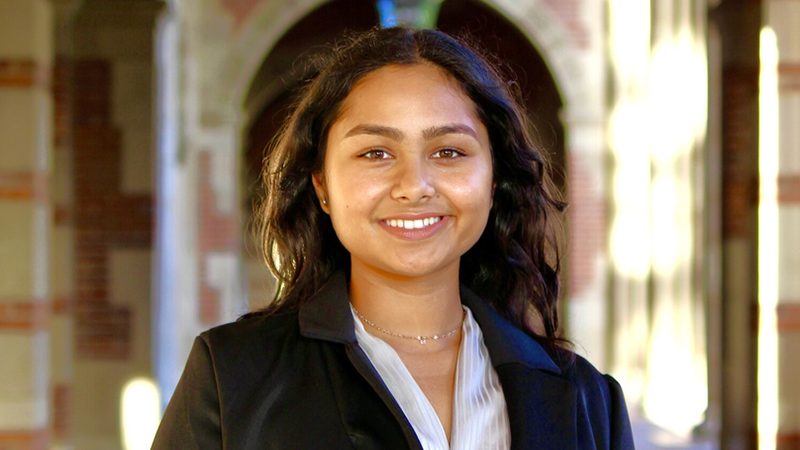
Courtesy of Ashita Singh
UCLA Samueli Newsroom
Ashita Singh remembers the first time code became something she could see.
She had written a few simple lines in C for a middle school robotics project and pressed run. Across the room, a small robot responded instantly — motors whirring as a mechanical arm lifted exactly the way she had instructed.
“Seeing that connection between code and the physical system was almost magical,” she said. “A few lines of instructions could control an entire mechanical structure.”
That moment stayed with her.
Singh grew up in the Bay Area, where Silicon Valley made technology a constant presence. She also spent years in Girl Scouts, mentoring younger students and organizing community projects.
By high school, she was already creating initiatives of her own.
Singh founded the Fremont chapter of Superposition, which encourages girls to pursue careers in science, technology, engineering and mathematics. She also launched a nonprofit initiative, Find Your Passion, helping underserved and first-generation students access extracurricular opportunities in STEM and the arts.
“The goal was simple: talent should not be limited by access,” she said.
Now a fourth-year computer science student at UCLA, Singh has spent her college years exploring a single question: How can emerging technologies, especially artificial intelligence, solve real problems?
The answer, she believes, lies as much in understanding people as it does in writing code.
When it came time to choose a university, Singh knew she wanted to study computer science. But she was also looking for a place where students didn’t just study ideas — they built things.
At UCLA, she quickly discovered that culture in the campus startup community.
During her first quarter, Singh attended an information session at Startup UCLA for Bruin Entrepreneurs, where students discussed early-stage companies and prototypes they were trying to launch. Soon afterward, she joined Bruin Entrepreneurs, a student organization dedicated to helping founders turn ideas into startups.
Eventually, Singh became director of the group’s Startup Labs program, a no-equity incubator for student founders. In that role, she helped guide 10 student startups from early concepts to working prototypes.
That emphasis on building practical solutions also shaped Singh’s own projects. In her freshman year, she and her teammates built a platform called ShelfMate for ENGR 170, an entrepreneurship course developed through Innovate@UCLA, a community and industry partnership program run by UCLA’s Office of Advanced Research Computing.
“The goal has never been just about writing code to make things work,” Ashita Singh said. “It’s to build systems that expand opportunity for people who might otherwise never have access.
ShelfMate helps users log the food they receive from food banks, track expiration dates and plan meals with available ingredients. The project enabled Singh and her teammates to think beyond code and algorithms.
“The biggest lesson was that social impact products require deep empathy,” Singh said. “The challenge isn’t just building the technology. It’s understanding the real constraints people face and designing something simple, practical and actually useful.”
That same year, she participated in the Innovation Challenge with Raffie, a collaboration among UCLA, AWS and LA28. Her team built an augmented-reality scanning app called Atlas for the Olympics. It allows spectators to point their phones at a sporting event on the screen and receive real-time information about the athletes and the rules.
Inspired by the growing impact of AI, Singh joined Bruin AI, one of the university’s largest student organizations focused on machine learning. Over time, she held several roles, including engineer and consultant, before eventually becoming the organization’s president in her junior year. In that position, Singh expanded the group’s emphasis on applied learning by building partnerships with industry and university programs so students could work on real AI projects with real stakeholders.
Under her leadership, Bruin AI also hosted the Southern California AI Ethics Conference, which brought together more than 400 attendees from more than 20 universities to discuss the societal implications of artificial intelligence.
Last year, Singh founded the AWS Cloud Club at UCLA to create a space for students interested in cloud infrastructure — the systems that power modern AI and large-scale applications. The club introduces students to cloud tools and how modern technology systems are built and scaled.
From her involvement in Bruin Entrepreneurs, Bruin AI and the AWS Cloud Club, Singh has discovered the importance of building communities where students can learn to create technology themselves.
“The problems that energize me most sit at the intersection of technology, people and real systems that shape everyday experiences,” she said.
On track to graduate this spring, Singh plans to continue working in artificial intelligence development and safety. She has accepted an offer from Google as a software engineer and says she hopes to contribute to building responsible AI systems in that role.
Eventually, she aims to start her own company to build technology that improves systems for the people who rely on them.
“The goal has never been just about writing code to make things work,” Singh said. “It’s to build systems that expand opportunity for people who might otherwise never have access.”