
Record-Setting Hydrogen Race Car Headlines UCLA Sustainable Energy Forum
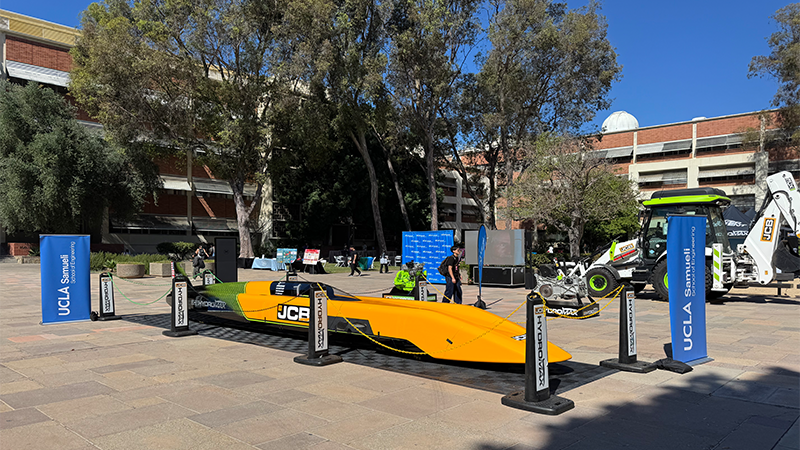
The world’s fastest hydrogen-powered race car rolled into UCLA Oct. 9, taking center stage at the Court of Sciences alongside student-built racing vehicles during a daylong expo and program featuring technical presentations and a panel discussion.
Sponsored by British agricultural and construction equipment manufacturer JCB and co-hosted by the UCLA Samueli School of Engineering and the Semel Healthy Campus Initiatives Center, the event brought together professional engineers, university researchers and students to explore hydrogen technology and its impact on the economy, the environment and human health.
The JCB Hydromax, which set a new world land speed record for a hydrogen-powered vehicle at 406.32 mph August 11 at the Bonneville Salt Flats in Utah, stopped traffic as onlookers gathered to take selfies with the sleek, 32-foot streamliner powered by two hydrogen-burning internal combustion engines. A hydrogen-powered backhoe was also on display, demonstrating potential applications of the technology beyond motorsports.
“JCB Hydromax represents our belief that we should not simply wait for the future to arrive, we should help build it,” said Alice Bamford, senior vice president of JCB North America. “Because that is how engineering moves forward. That is how records are broken. That is how history is made. That is how the future is brighter.”
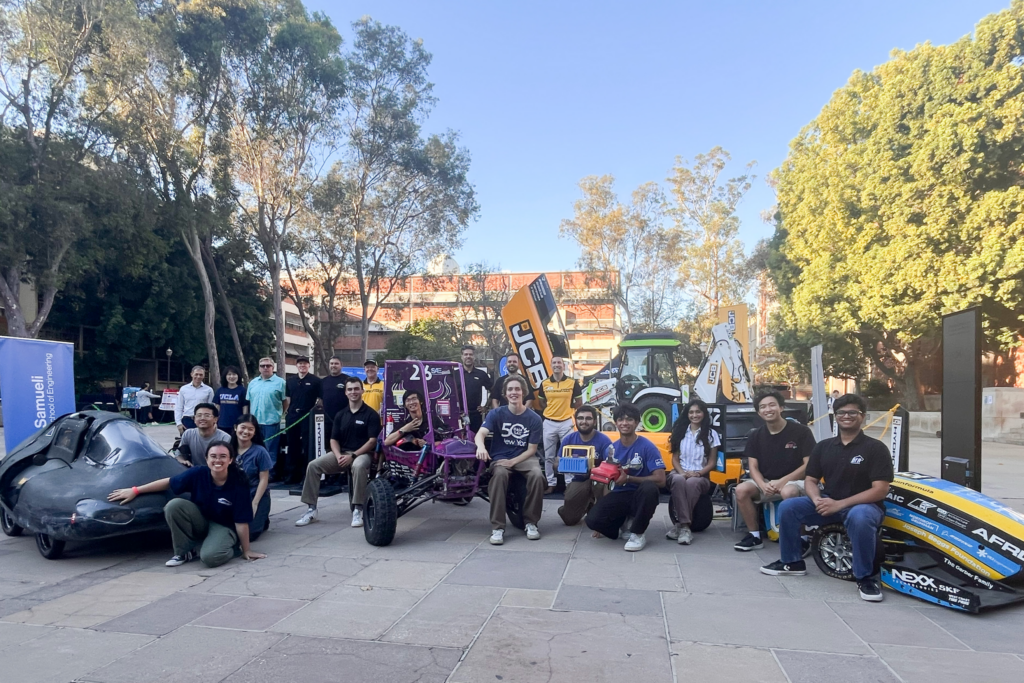
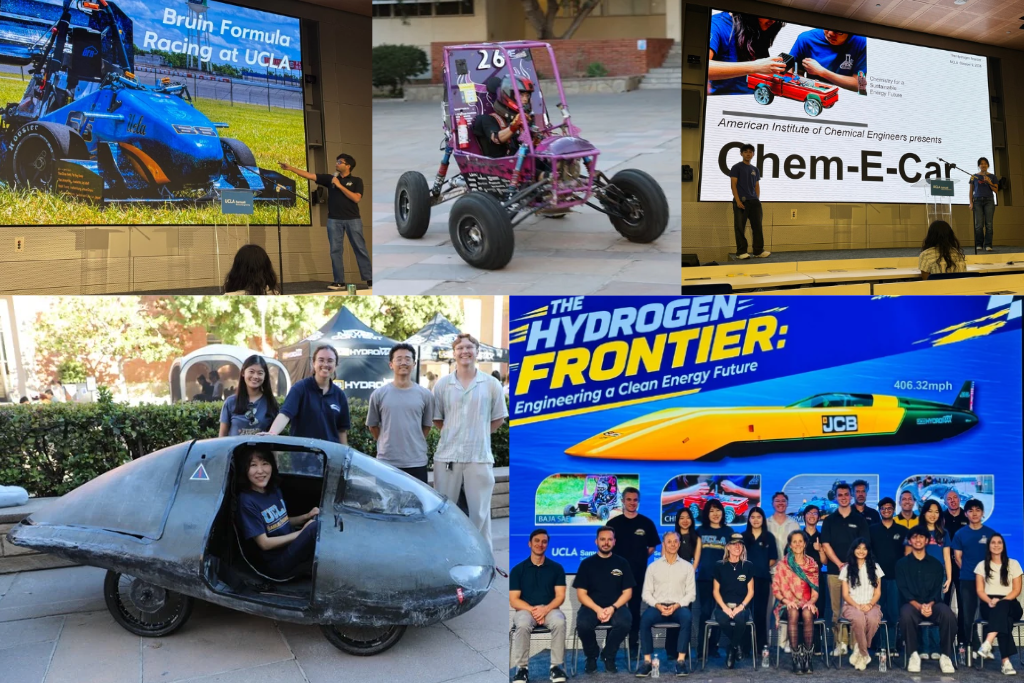
UCLA’s student clubs showcased vehicles they built from scratch, each employing a different approach to increasing speed while maintaining energy efficiency. Three came from Bruin Racing teams: a hydrogen-powered Supermileage car that debuted earlier this year in the Shell Eco-marathon at the Indianapolis Motor Speedway, an electric Formula racing car built to balance speed and endurance, and a Baja off-road vehicle designed to navigate rough terrain.
Members of Chem-E-Car, a team affiliated with the American Institute of Chemical Engineers at UCLA, also displayed a toaster-sized vehicle powered by chemical reactions and designed to stop after traveling a predetermined distance.
Turning Biomass and Plastic Waste Into Hydrogen Fuel
The showcase extended beyond vehicles to research on producing hydrogen fuel. Climate technology company Mote, a spinout of Lawrence Livermore National Laboratory, presented its work on clean energy production and carbon removal. The company is also collaborating with UCLA Samueli researchers on a pilot project to convert campus biomass waste into hydrogen while capturing carbon dioxide.
The UCLA research is led by Dante Simonetti, an associate professor of chemical and biomolecular engineering who moderated a panel discussion featuring representatives from JCB, Mote and UCLA’s student engineering teams, as well as an MBA student from the UCLA Anderson School of Management. Panelists discussed the engineering, environmental and business considerations involved in developing cleaner energy technologies.
Hydrogen technologies are also a focus of Ah-Hyung “Alissa” Park, the Ronald and Valerie Sugar Dean of Engineering at UCLA Samueli. A professor of chemical and biomolecular engineering and civil and environmental engineering, Park studies sustainable energy and materials conversion, including methods for producing hydrogen from mixed plastic waste without first sorting it.
“Students and faculty members are dreaming the future where we don’t need to burn fossil fuels anymore,” Park said, highlighting research groups across the school working on hydrogen technologies. “All the mobility, all the empowerment we are doing with the heavy industries and cars will be much more friendly for our future generations and our Earth.”
Beyond transportation and energy production, the discussion explored the broader implications of sustainable energy technologies and environmental conditions for human health and food systems.
“Frontiers are places of discovery,” said Darnell Hunt, UCLA’s executive vice chancellor and provost. “They challenge us to imagine what is possible, and then do the hard work of making it real.”
Wendelin Slusser, associate vice provost for the Semel Healthy Campus Initiatives Center, highlighted the potential benefits of cleaner agricultural equipment, drawing on her family’s history in farming.
“As a fifth-generation farmer myself, it would be a dream come true to have a hydrogen-powered engine for tractors,” Slusser said. “That would be a step toward a food system with lower emissions and one that our brains and planet will thank us for now and for generations to come.”
Following the discussions, attendees gathered at the Court of Sciences to see the vehicles and speak with representatives from the participating organizations. While most of the vehicles remained stationary, the Bruin Racing Baja team took its off-road car for a spin around the South Campus quad.