
UCLA Engineering Professor Shafayat Hossain Receives DARPA Young Faculty Award to Explore Quantum Vacuum Phenomena
Courtesy of Shafayat Hossain
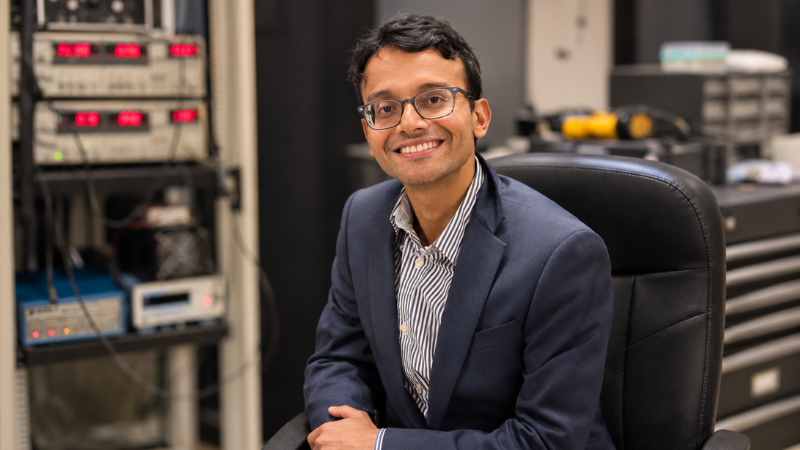
Shafayat Hossain in his lab
The project will investigate quantum phenomena in a vacuum, where quantum fields can exhibit fluctuations even in the absence of particles. Using specially designed devices made from novel quantum materials, Hossain’s team will study how quantum detectors interact with these fields and whether they can extract quantum correlations from the vacuum, then transfer the resulting entanglement to the detectors in a process known as entanglement harvesting. By studying how quantum fluctuations and correlations affect detector behavior, the researchers aim to uncover principles that could inform the development of quantum communication, sensing and signal detection technologies.
Hossain, who joined UCLA Samueli in July 2025, leads the Quantum Materials Intelligence & Nano Devices Lab, where he designs advanced materials for energy-efficient electronics and next-generation quantum devices. He is also a member of the California NanoSystems Institute at UCLA.
In addition to the DARPA award, Hossain has recently received a three-year, $570,000 grant from the National Science Foundation to investigate a class of quantum materials called topological insulators. These materials conduct electricity along their surfaces while their interiors remain insulating. Their electronic properties also protect the flow of electrons from defects and disturbances. These properties make them promising candidates for high-speed electronic devices.
Working with co-investigator Alexander Balandin, the Fang Lu Professor in Engineering and a distinguished professor of materials science and engineering at UCLA Samueli, Hossain will explore ways to improve electron transport in topological insulators at room temperature, a step toward making these materials more practical for everyday electronics.