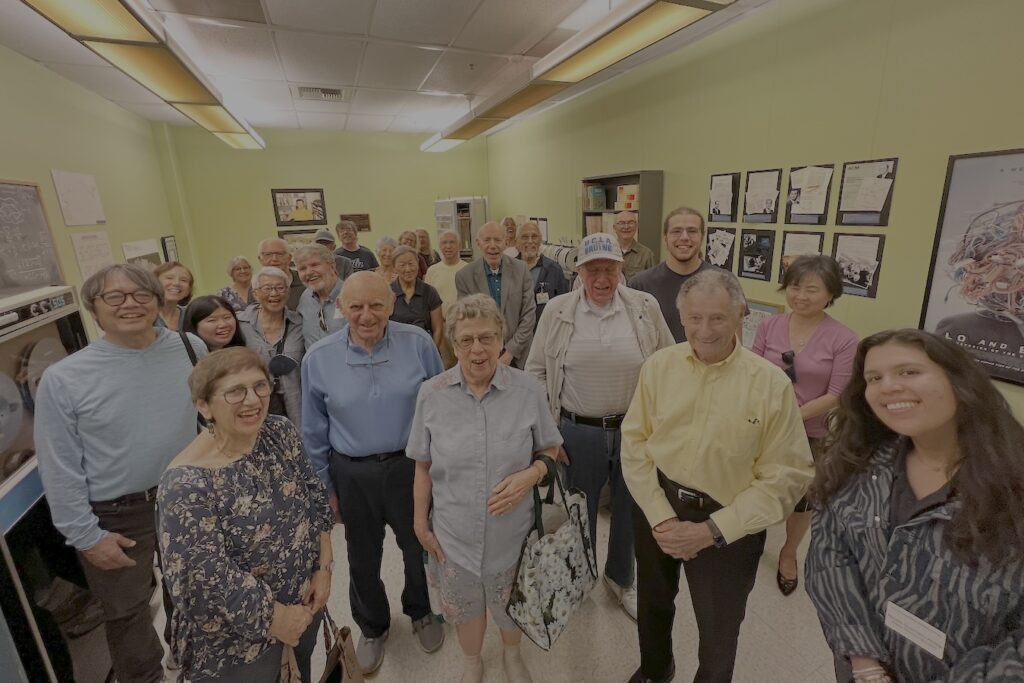
UCLA Internet Pioneer Leonard Kleinrock Has the Best Advice for Handling Changing Times
57 years after the first internet message, the legendary professor looks back on a lifetime of innovation and shares lessons for the next generation
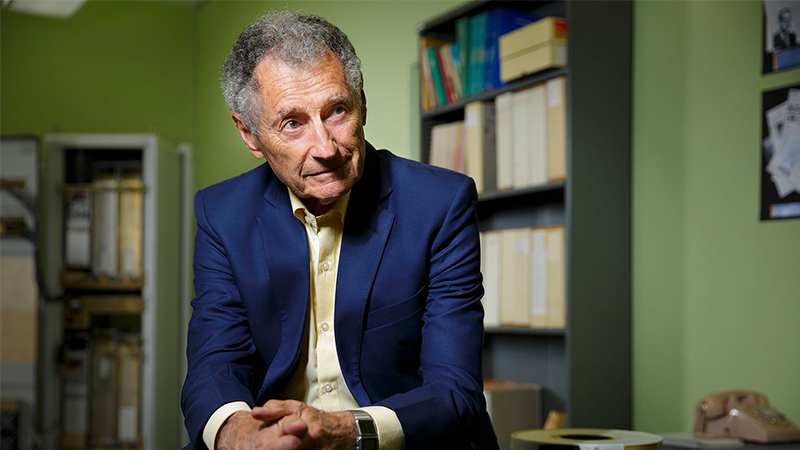
Whether you’re just starting out in college or are several decades into a career, adapting to technological change can be tough. Today, artificial intelligence is rapidly causing us to adjust how we learn, communicate, work and even behave. Before that, it was smartphones, the internet, computers, television, radios, landlines and even the telegraph that led to these kinds of major societal changes.
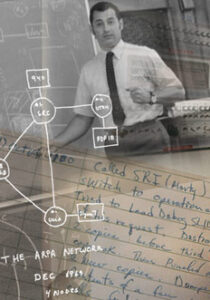
Kleinrock at UCLA in 1970. His groundbreaking work helped lay the foundation for the internet.
Few people have had a better front-row seat to this technological roller coaster than Leonard Kleinrock.
Born in 1934, the distinguished professor of computer science at the UCLA Samueli School of Engineering has witnessed nearly a century of technological advances — and helped usher in a major revolution of his own. On Oct. 29, 1969, just six years into his UCLA career, he and his team sent the first message over the ARPANET, which would eventually become today’s internet.
And yet for someone who helped create the digital age, Kleinrock’s advice for navigating an increasingly unpredictable future is surprisingly timeless: Stay curious. Embrace opportunities. Don’t be afraid to change direction. And whatever you do, do it well.
For the 57th anniversary of that first host-to-host message between networks at UCLA and the Stanford Research Institute, Newsroom caught up with Kleinrock to revisit his remarkably prescient predictions about the internet, hear how a childhood spent tinkering with radios shaped his career and find out what he’d tell the next generation of innovators.
Responses have been edited for length and clarity.
In a July 1969 UCLA press release, ‘UCLA to be First Station in Nationwide Computer Network’ (PDF), you predicted that computer networks would eventually become utilities serving homes and offices across the country, much like electricity and telephone service. Looking back, it seems like you nailed it.
Well, yes and no. There’s one major thing I missed — I totally missed social networks. I didn’t talk about people talking to each other. I didn’t realize that until email came along, and I noticed that it suddenly took over the traffic of the network. So that’s one thing.
And when I talked about being able to access it everywhere, that’s like web-based services, computer utilities today. When I talked about telephone and electric systems, that means essentially invisibility and ubiquity. But we don’t have an invisible network; invisibility means I should walk into a room, and it should know I’m there. I should be able to talk to it, use gesture, touch, voice, visual cues and all the rest. So, I missed social networks on the one hand, but the world has not yet caught up to my predicted invisibility.
You’ve spent your career working at the vanguard of fields that are constantly evolving. What experiences helped you develop the curiosity and flexibility to keep exploring new territory?
I can attribute part of it to the way my parents — in particular my mother — allowed me to experiment on anything I wanted. We were poor and lived in a tough neighborhood in Manhattan. As a kid, I began building radios. Building radios is a sloppy job involving soldering irons, vacuum tubes, wires, chassis, tools, etc. I hid all that mess behind the sofa in the living room, and my mother didn’t stop me. She could have said, “Keep it clean, get out of here!” She had no idea what I was doing, but she gave me the freedom to explore what I wanted, which I think was a very great enablement, because I followed that throughout my life.
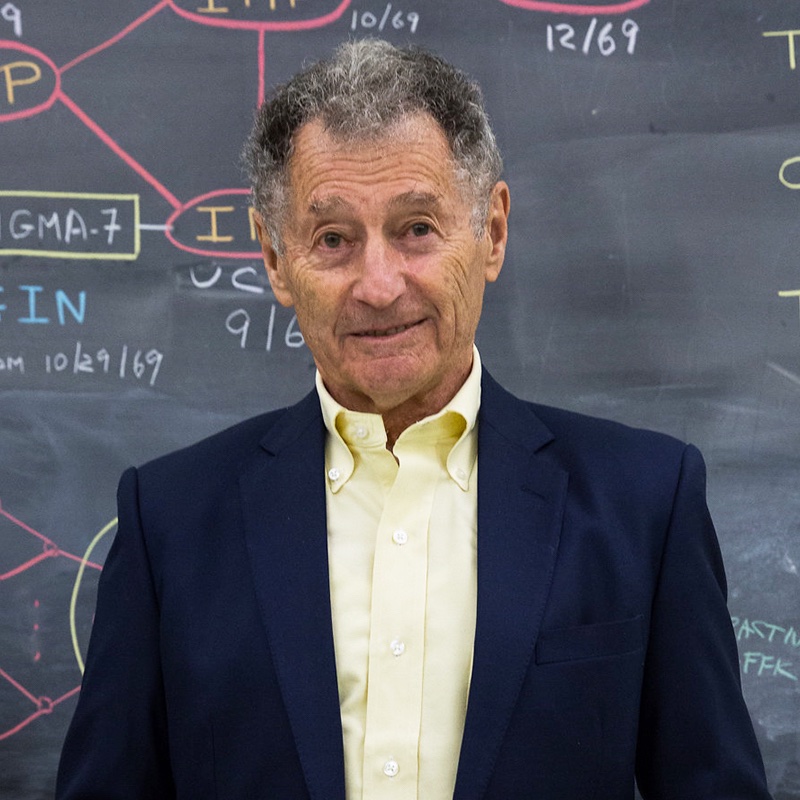
Kleinrock stands before a chalkboard illustrating the early ARPANET, the network that would evolve into today’s internet.
And I was very lucky to go to really great schools. My public education in New York was terrific. I went to a great high school, the Bronx High School of Science. I went to City College of New York — but I went to night school, with the GIs and the “crazies.” During the day, I was working as an assistant engineer, so I had a very broad experience. I got a good sense of the practical, real side of engineering, and I got the theoretical side at night. And the professors teaching me at night were also working during the day, so they had that practical side as well.
One night, a professor came into the class, and he said, “You see this? It’s called a transistor” — that technology was just coming in. And he said, “It’s a better thermometer than it is an amplifier.” Why? Because it was very sensitive to heat, and as the heat of the environment in which it was operating changed, its operating characteristics would change. “And by the way, students,” he said, “here’s how to fix that.”
Had he been a daytime professor, he would have said, “See this transistor? Here’s how it works.” End of story. So, I got a very rich mix of intuitive engineering and theoretical understanding, and that combination allowed me to take on almost any problem and look at it from all the various aspects.
I like to point this out to my students: Engineers typically ask the question of how something works. They look at it and they say, “Ah, let’s measure it, let’s break it, let’s open it, let’s design it, let’s build it.” But a scientist typically will ask: Why does it work that way, what are the physics and the mathematics behind it? Those are different questions. They’re both very valuable. Fortunately, I could do both, and it enabled me to look at systems and problems and challenges in a variety of ways.
Typically, when I would work in a field and try to work on the frontier, once it got started there would be a voluminous amount of new papers coming out. The literature would explode. That’s the time to leave. When you can’t read all the literature, shift a little bit to another area where what you have still works but applies to a different domain. I’ve been able to do that. I moved to nomadic computing, wireless computing and a variety of things.
What advice do you give your students and other young people about building a career and being ready for opportunities they might never see coming?
I give them a lot of lessons. One is that, for young people, when you achieve your first success, whether it’s a piece of music, some literature, a poem, an engineering job, becoming an Eagle Scout — in my case, it was becoming an Eagle Scout — once you do it, keep that inside and know that you can do it again.
I was challenged to become an Eagle Scout, the first one in my troop, and that was a challenge that seemed way beyond my grasp. It’s tough, you know. But I worked at it really hard, and I got it — bingo! And I could say to myself, “Look, if there’s a tough challenge and you go after it, there’s a good chance you’ll succeed.” So I tell my students, whatever you accomplish, know that you can do it again. That’s a good thing to keep in mind.
You’ve also encouraged younger generations to listen to their elders rather than assume they know more about a rapidly changing world. Why is that lesson so important?
There’s a wonderful story that goes with that. It’s a joke, but it makes the point: This older man was sitting at a ball game, watching from the bleachers, and next to him was a young man also watching. Every so often, the young man would look over at the old man. Finally, the young man said, “Excuse me, sir. You know, I realize I can’t communicate with you. I mean, when you grew up, you didn’t have television, you didn’t have the internet, you probably didn’t have airplanes. You didn’t have wireless. I can’t communicate with you.” So the old man said, “You know, son, you’re right. We didn’t have those things, so we had to invent them. What the hell are you going to do for the future?’