
Frog-like Hopping Robot Propelled by Twisting Elastic Rods
Low-power actuators unleash stored energy in sudden bursts, allowing movement over challenging terrain
Dezhong Tong/University of Michigan
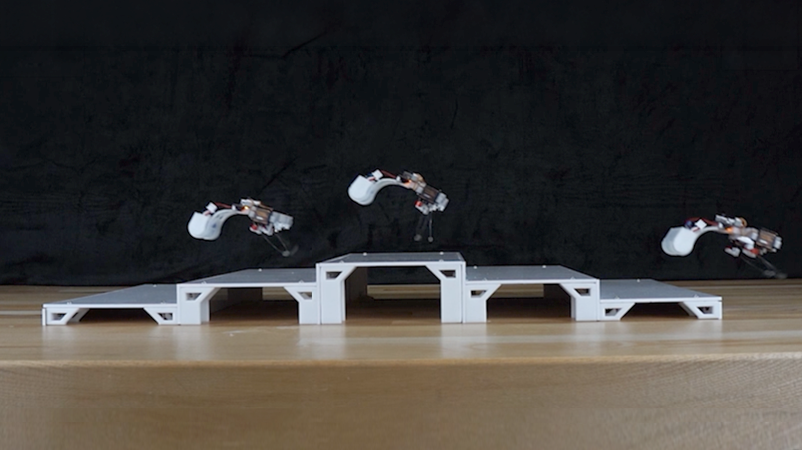
The robot shown leaping up a set of small steps, with the loops at the rear blurred by the snapping motion
Roboticists at the UCLA Samueli School of Engineering and the University of Michigan have shown that elastic rods can be bent and twisted to repeatedly snap between shapes, releasing built-up energy that enables small robots to hop, flip and swim.
The study, published in Science Advances, could offer a promising new approach to movement for robots constrained by size, weight and power output. The snapping mechanism could also help robots move across uneven terrain, on land and in water.
The research is co-led by Khalid Jawed, an associate professor of mechanical and aerospace engineering at UCLA Samueli who leads the Structures-Computer Interaction Lab, and Xiaonan (Sean) Huang, an assistant professor of robotics at Michigan.
When an elastic rod is bent and its ends are rotated, energy builds up within the rod as it deforms. At a critical point, the rod can transition to a new shape, releasing some of the stored energy in the process. The researchers found that some shapes deform gradually while others snap rapidly and release stored energy in a sudden burst, making the choice of geometry key to producing the strong, repeatable snapping motion.
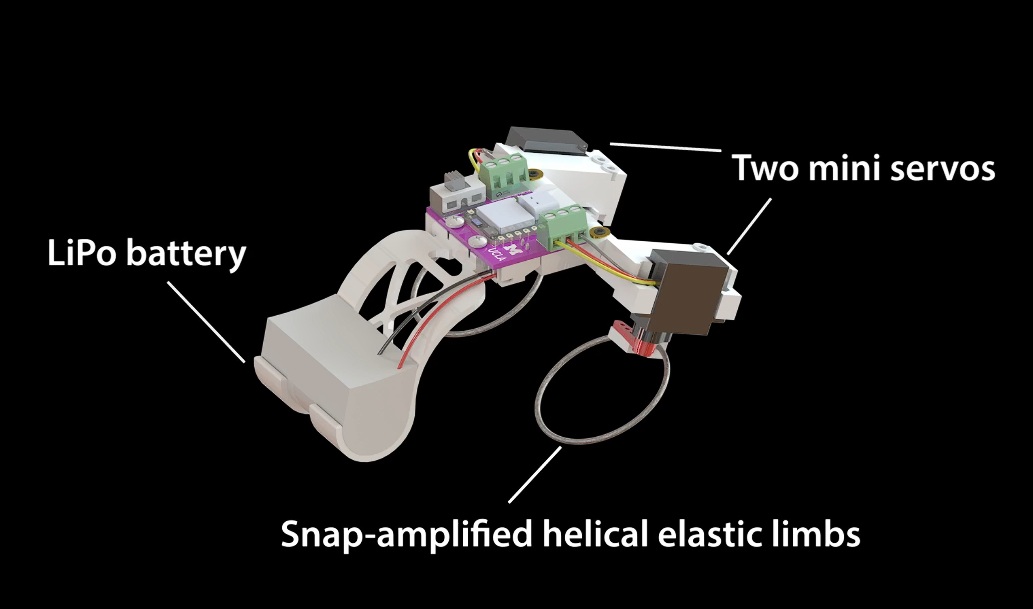
Unlike conventional beams, columns or trusses, the elastic rods combine bending, twisting and compression, enabling large three-dimensional deformations and directional releases of elastic energy. The helical shape can also be created by using a motor to move and rotate the ends of a naturally straight rod, offering a relatively simple mechanism for powering movement in small robots.
“Because it’s the rod’s shape — not its size — that determines whether it snaps sharply or deforms gradually, the same design rules apply across a wide range of scales,” Jawed said. “This opens a promising path toward robots just a few millimeters wide, turning small motor movements into powerful bursts of motion.”
Dezhong Tong/University of Michigan
A diagram of the hopping robot. When the helical elastic limbs at the back are twisted, they produce a snapping motion, propelling the robot forward with a hopping motion reminiscent of a frog.
Timing the Snap for Optimized Energy Release
In their experiments, the researchers first created computational models of elastic rods to predict how they would respond under different combinations of bending and twisting. They then tested these predictions by using a robotic arm to repeatedly deform physical rods.
Using the design rules established by their simulations and experiments, the researchers designed and built a frog-like robot prototype with helically shaped elastic rods as snap actuators. A rotating motor repeatedly bends and twists each rod until it reaches a critical point and snaps into a new configuration, converting stored elastic energy into rapid, repetitive movements. Because the rod itself stores and releases the energy, a small, low-power motor is enough to trigger the snap. The motor only has to slowly wind up the rod, while the sudden release of stored energy pushes the robot forward.
“Once we could predict when a rod would snap, we could use that sudden release of energy to turn a simple motor movement into a powerful push that sends the robot hopping forward,” said study co-first author Dezhong Tong, who worked on the project while a doctoral student in Jawed’s group at UCLA and is now a postdoctoral researcher with Huang at Michigan.
Small But Mighty: Hopping, Flipping and Swimming
At just 11 centimeters long and weighing 98.2 grams (less than a quarter of a pound), the frog-like hopping robot could move across a range of surfaces, including wood, cloth, acrylic, leather, grass and sand, and could even climb a series of steps. A video demonstrating the robot prototype’s capabilities can be accessed at this link.
Compared with a rigid-legged robot, the snap-actuated prototype moved faster across all six tested surfaces, reaching a peak of 3.21 body lengths per second on wood and averaging 2.46 body lengths per second across all six terrains, versus just 0.79 body lengths per second for its rigid-legged counterpart. The gap was starkest on cloth and grass, where the rigid-legged robot nearly stalled. The snapping mechanism also enabled the robot to launch into the air and perform repeated backflips. Fitted with thin flexible fins, the same robot swam at about 0.5 body lengths per second and was able to turn and navigate around obstacles even when subjected to wind disturbances.
The team also demonstrated the snapping actuator’s versatility in more complex environments. Researchers teleoperated the robot through a sandbox containing rock obstacles and paired its movement with light sensors to demonstrate autonomous steering.
“The broader opportunity is to let the mechanics of the robot do some of the work that would otherwise require larger motors or more complicated control,” Huang said. “By programming when an elastic structure stores and rapidly releases energy, we can give small robots access to powerful, repeatable motions without continuously demanding high output from the motor.”
The paper’s other co-first author is Jiaqi Wang, a doctoral student at Michigan. Other authors are Zexiong Chen, a former graduate student at Michigan; Andy Borum, an assistant professor of mathematics and statistics at Vassar College in New York; and Weicheng Huang, an assistant professor of mechanics and robotics at Newcastle University in the United Kingdom. The research was funded by the National Science Foundation.