
From Backyard Ziplines to Self-Driving Cars: UCLA Computer Science Student Develops Tools to Help Autonomous Vehicles Safely Share Information
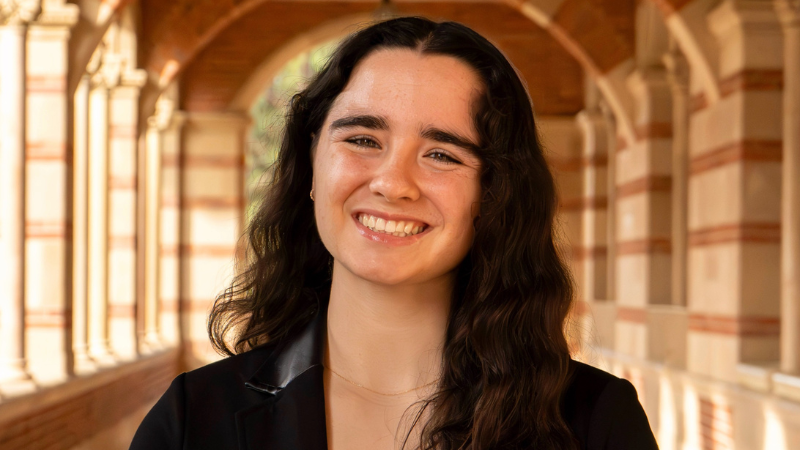
One of the fondest childhood memories of Alexandra Markova was a weekend spent running around Home Depot with her father and three siblings. They gathered parts to string a makeshift zipline across the backyard of their home in a small Illinois town before the family moved to the Bay Area in California. That was her introduction to engineering.
Both of Markova’s parents were engineers who immigrated to the United States from Bulgaria. They encouraged their children to build anything they could imagine — putting together a bunk bed, assembling mechanical arms and modifying a kid-sized go-kart complete with mirrors and lights. Their encouragement sparked her curiosity, and since then she has always had a running list of projects — and the instinct to bring her ideas to life.
Markova’s father, a software engineer, tried to get her interested in coding from an early age and an elementary school coding class piqued her interest. But it wasn’t until middle school, during the COVID-19 pandemic, that she started working on her own projects and taking computer science courses on the online learning platform Coursera.
The machine learning course taught by Andrew Ng, a co-founder of Google Brain and Coursera, was her first real exposure to artificial intelligence. Most of the math went over her head, she said, but the idea that a program could predict and analyze data in ways she had never imagined got her hooked.
“Everybody has something that feels like magic to them, something that lets them do what shouldn’t be possible, and that’s what computer science is for me,” she said.
When it came time for college, Markova picked UCLA not only because it’s relatively close to her family in Northern California but also because of the collaborative culture she noticed on Bruin Day — an annual open house event where newly admitted students and their families can explore the campus before making their enrollment decisions.
“One of the largest differences I noted between UCLA’s admit day and those of other top engineering universities was how much everyone here smiled and seemed to genuinely want to talk with prospective students,” said Markova, who still keeps in touch with many of the upperclassmen she met that day.
Research on Making Self-Driving Cars Safer
Now a rising second-year computer science student at the UCLA Samueli School of Engineering, Markova conducts research at the UCLA Mobility Lab, which is directed by Jiaqi Ma, a professor of civil and environmental engineering and computer science at UCLA Samueli. She and other lab members are developing a trust system for cooperative perception in autonomous vehicles.
“I want to be the kind of engineer who thinks about the societal impact of their work and ensures that it’s for the better,” said Alexandra Markova.
Self-driving cars act on what their sensors can see, and they inherit the same blind spots as human drivers, such as a pedestrian hidden behind a pole or a child stepping into the street between two parked cars. Cooperative perception addresses these gaps by allowing nearby vehicles to share what they see, creating a more complete picture of the road than any single car could achieve alone.
Since April, Markova and her colleagues have been working on developing a system to identify the type of vehicle data that is safe to trust. Bad data are worse than no data, she said, and determining which information can be trusted is difficult. Relying on information from poorly calibrated sensors or compromised vehicles could lead to real danger on the road.
“The hardest problem is verifying something you can’t see for yourself,” she said. “You have to decide whether or not to trust the data, and both choices have a cost.”
Markova is also a reinforcement learning fellow with AI Safety at UCLA, a student research club for creating safe and robust AI systems. There, she has learned about the math, implementation and safety principles behind reinforcement learning. She said the experience has led her to consider how the decisions made by developers can ultimately shape the way technology is used.
“It’s important to remember that, as engineers, we’re not just making nifty systems,” she said. “We’re determining whether someone gets home safely. There are real implications for people.”
Beyond the Lab
In a first-year software construction course, Markova and three classmates created Bruin Bet, a prediction market modeled on Polymarket but centered on UCLA campus life. For Markova, projects like Bruin Bet also reinforce what first drew her to building things: the satisfaction of turning an idea into something real.
Outside the classroom, Markova is vice president of operations at Bruin AI, a student organization that pairs members with startups and other companies on projects and organizes the SoCal AI Industry and Research Summit, one of the largest student AI conferences in Southern California. She joined the group as a project developer and now handles logistics, events and budget decisions.
She is also a fitness instructor with UCLA Recreation and plays intramural soccer. She said staying active is the best way for her to maintain her mental health and productivity.
Looking to the future, Markova says she wants to build AI systems with tangible impact while considering their broader effects on society. No matter what she builds, Markova said she intends to consider potential biases and implement safeguards early in the process.
“I want to be the kind of engineer who thinks about the societal impact of their work and ensures that it’s for the better,” Markova said. “I don’t know yet what my path should look like, but I figure if I keep following problems that interest me and stay true to my values as an engineer, I’ll end up alright.”