
Bruin Engineer Fred Rosenthal’s Blueprint for Building a Meaningful Life
Courtesy of Fred Rosenthal
“If you’re fortunate enough to be successful, give back at whatever level you can. Get involved after a few years in the workforce — join boards, contribute and learn from other alumni. It’s a great way to invest in students and give them more opportunities to study and pursue engineering.” – Fred Rosenthal
Born and raised in Los Angeles, Fred Rosenthal ’81 grew up around his father’s business, drawn to anything he could take apart, build or improve. “When I was a young kid, soldering intrigued me,” he says. “I was always drawn to electrical things, like making little kits.” That early fascination would become the foundation of his education — and the reason an electrical engineering degree at UCLA felt less like a choice than an inevitability.
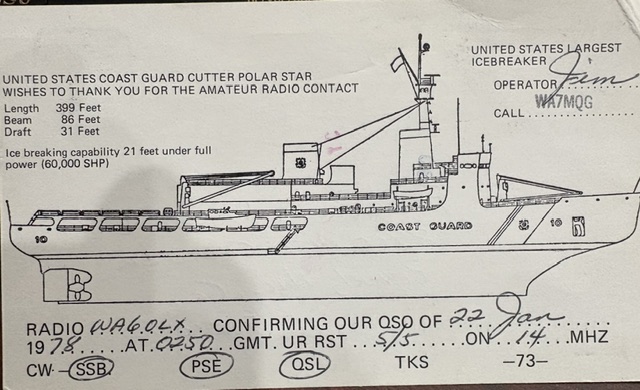
Rosenthal’s curiosity found its fullest expression in ham radio. He earned his Federal Communications Commission license at age 14, the result of a bargain with his father: get licensed and they would build a radio tower at the family home. The hobby followed him to UCLA, where he joined the Engineering Ham Radio Club and used the tower on the roof to talk across the globe. “Electrical engineers tend to be ham radio geeks,” he says. “It’s a common interest.” He still keeps a collection of QSL cards — the postcards ham operators mail one another to confirm a radio contact — some now more than 50 years old, each logging a conversation with a stranger in a distant country. It was hands-on, experimental, build-it-yourself learning, and it was exactly the kind of education he would later want to help provide for others.
His choice to attend UCLA was very deliberate. “It had a great reputation and the kind of course rigor that I was interested in,” he says. Two of his older siblings had gone to MIT, but his sister had warned him that MIT was “all academics,” he recalls. “That’s another reason why I picked UCLA, because it’s very well-balanced. I could study and enjoy myself.” Being well-rounded is something he has always prized — and it is part of why engineering appealed to him in the first place. UCLA gave him room to pursue that ideal: a place where serious technical work and extracurriculars could coexist.
Rosenthal arrived at UCLA during the dawn of personal computers and the early internet — and was immediately drawn to all of it. He moved through the program with characteristic drive, finishing his engineering degree in just three years. The pace worried then-dean A.R. Frank Wazzan. “He said, ‘Fred, most people spend five years to finish undergrad. You’re going to try to do it in three years — why the rush?’” Rosenthal recalled. He was eager to start applying his technical knowledge in the real world, and the conversation shaped his perspective on engineering and business for years to come. He went on to build a wide-ranging career, pursuing an MBA, and working as an electrical engineer, an attorney and a real estate investor. He is clear, however, that the foundation — the curiosity, the rigor, the love of building — was laid at UCLA.
Looking back, his determination and ambition were forged early. A high school counselor had once told him he wasn’t cut out for college and should consider trade school. His wife, Eugenia, sees that moment as formative. “That drove him,” she says. “He wanted to prove that he absolutely could do it.” He proved it at UCLA — and never forgot what the school gave him.
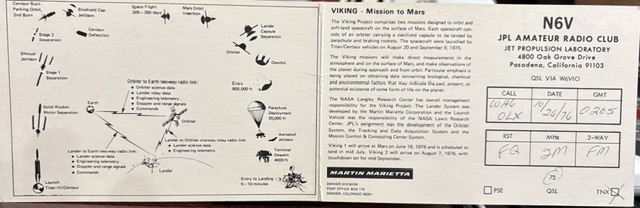
QSL card dated Oct. 26, 1976, documenting Fred Rosenthal’s amateur ham radio communication with NASA’s Viking spacecraft during its mission to Mars
What followed was a career that combined every one of his interests. While studying for his MBA, Rosenthal worked for Eli Lilly, where he designed a microwave radio system that enabled the company’s Indiana plants to communicate without leasing expensive data lines. That work led to a job at AT&T in Los Angeles, where he managed some 20 engineers. When the company offered to pay for law school in exchange for a three-year commitment, he did the math and declined it on principle, ultimately deciding to pursue law school on his own terms. After graduating, he joined a real estate law firm and then took over his father’s business. Today he continues to work across engineering, business and law through his audio-visual company and real estate investment portfolio. “How they’re all connected, I don’t know,” he said, “but I have these interests, and I pursue them.”
That same philosophy shaped his first $25,000 leadership-level gift to UCLA Samueli’s Engineering Student Projects Fund. He had never been asked to give until he joined the school’s Engineering Alumni Association (EAA) Board, where student presentations opened his eyes to the opportunities he wished he’d had as an undergraduate. “I wished I’d had the opportunity to get funding for a project when I was in college. Student projects give practical, hands-on experience that helps students discover what they like, and which discipline they want to pursue,” he says. For Rosenthal, that discovery is the whole point of an engineering education.
The gift also reflects a renewed relationship with his alma mater. Through the EAA Board, he started attending meetings at UCLA, got more involved, and discovered he liked it — reconnecting with how dramatically the engineering school has grown since his student days. Serving on the board introduced him to peers from across the field. “We’ve all been working in some kind of engineering field and we’re accomplished,” he says. “I always like learning about other people’s perspectives.” Most notably, he recalls meeting Dean Alissa Park. “I never had a dean who is so engaging and warm,” he says. “It showed me a whole other side to the engineering school.” Overall, the experience has confirmed for him that “it’s rewarding to see how what you invest in college can benefit you many times over.”
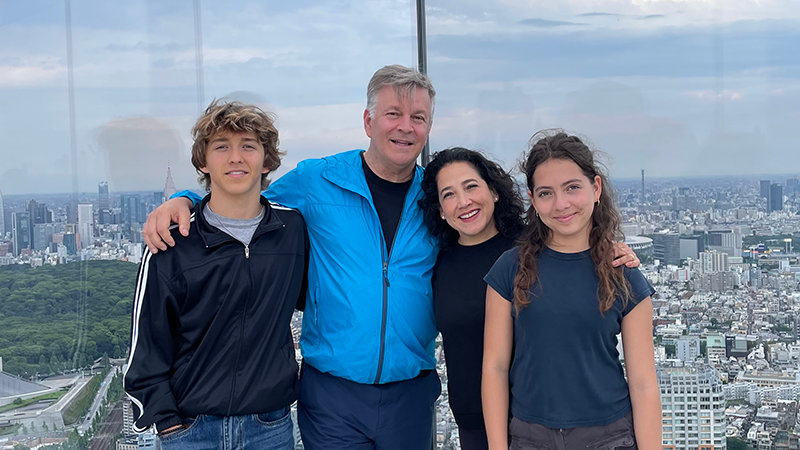
For the Rosenthals, that spirit of contribution runs through family life too. With children, Sam, 18, heading to college and Elle, 16, in 11th grade, Eugenia describes a close-knit household centered on school, synagogue and community. “We don’t just focus on success and making money,” she said. “We focus on success as a whole — finding something you enjoy doing that will make the world a more meaningful, more rich, fairer place for everyone.”
Rosenthal’s message to fellow alumni considering their first leadership-level gift is as direct as it is generous. “If you’re fortunate enough to be successful, give back at whatever level you can. Get involved after a few years in the workforce — join boards, contribute and learn from other alumni. It’s a great way to invest in students and give them more opportunities to study and pursue engineering.”